
When people talk about GPUs, they usually focus on specifications such as CUDA cores, Tensor Cores, or raw computing power. However, as artificial intelligence models continue to grow in size and complexity, another component has quietly become one of the most critical resources in modern AI infrastructure: VRAM (Video Random Access Memory).
In simple terms, if a GPU is the engine that performs billions of calculations every second, VRAM is the workspace where those calculations happen. Without sufficient memory, even the most powerful GPU cannot fully utilize its computing capabilities because the model and its intermediate data simply cannot fit inside the available memory.
This limitation becomes especially apparent with large language models (LLMs) and generative AI systems. Running or fine-tuning models with billions of parameters requires storing weights, activations, attention caches, and context windows directly inside GPU memory. Once VRAM runs out, the system must offload data to system RAM or storage, dramatically reducing performance or preventing the model from running altogether.
According to NVIDIA’s guide on inference optimization: keeping models fully resident inside GPU memory is one of the most effective ways to maximize AI performance. Similarly, Hugging Face recommends evaluating GPU memory requirements before choosing deployment strategies or optimization techniques. As AI models continue to evolve, VRAM is no longer just another specification on a datasheet. It has become a fundamental requirement for building scalable AI systems.
VRAM Determines Whether A Model Can Run At All
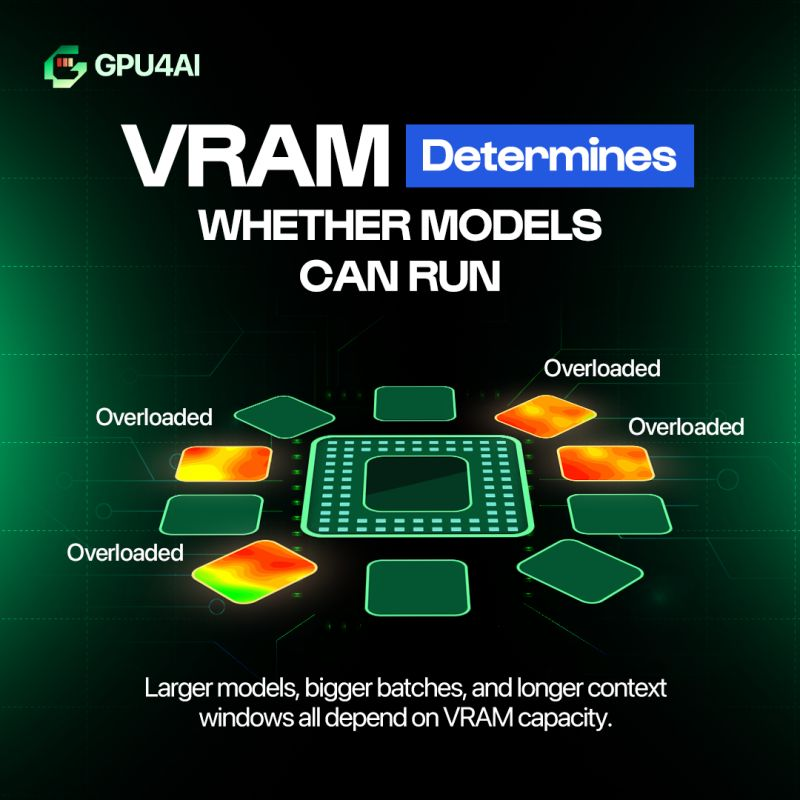
One of the biggest misconceptions about AI hardware is assuming that computational power alone determines performance. In reality, before a model can execute a single operation, it must first fit entirely inside GPU memory.
If the required memory exceeds available VRAM, the model simply cannot load. This often results in Out of Memory (OOM) errors, even on otherwise powerful GPUs.
Modern foundation models such as Llama, Qwen, and advanced diffusion architectures require substantial memory capacity, particularly when running in full precision. Although quantization techniques can reduce memory usage, VRAM remains the first hardware constraint engineers evaluate before deployment. Microsoft’s AI infrastructure documentation also emphasizes planning GPU memory requirements early to improve deployment reliability and scalability. In other words, VRAM determines whether a model can run before performance optimization even becomes relevant.
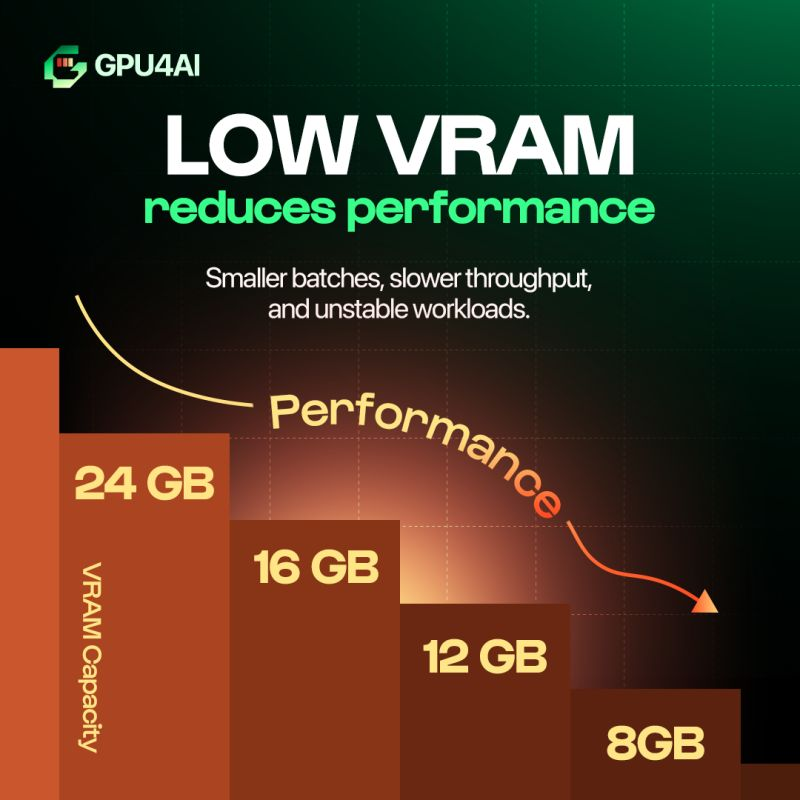
Insufficient VRAM Doesn’t Just Cause Errors—It Reduces Performance
Many AI systems can technically operate with limited VRAM by offloading data to system memory. However, this comes with significant performance penalties. Whenever the GPU needs to retrieve data from RAM instead of local VRAM, latency increases because PCIe bandwidth is dramatically lower than on-board memory bandwidth. As a result, token generation slows down, image synthesis takes longer, and overall throughput decreases.
For production AI services handling thousands or millions of requests every day, even small increases in latency can translate into substantial infrastructure costs and degraded user experience. NVIDIA identifies keeping inference workloads entirely within GPU memory as one of the most effective optimization strategies for maximizing throughput. This explains why many AI organizations prioritize GPUs with larger memory capacity rather than focusing exclusively on raw compute performance.
VRAM Is Becoming A Strategic Resource For The AI Economy
As AI systems become increasingly sophisticated, the competition is no longer centered solely on computational power. Memory capacity has become equally important. Long-context language models, multimodal AI, video generation systems, and autonomous AI agents all require significantly larger memory footprints than previous generations of machine learning applications. Consequently, VRAM is rapidly evolving into one of the most valuable infrastructure resources for AI development.
According to NVIDIA’s data center roadmap: modern architectures such as the H100 and Blackwell platforms significantly expand both memory capacity and memory bandwidth specifically to support next-generation AI workloads. From a business perspective, this means organizations should evaluate GPU infrastructure based not only on FLOPS but also on VRAM size, bandwidth, and long-term scalability.
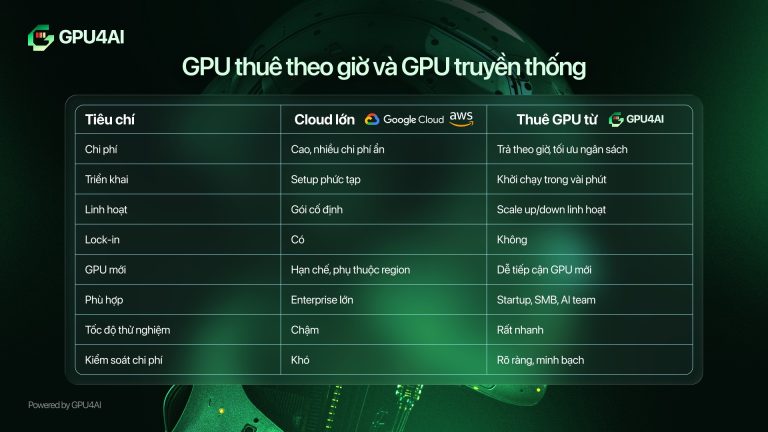
For startups and growing AI companies, flexible Cloud GPU platforms provide an efficient way to access different VRAM configurations without investing heavily in physical infrastructure. Instead of purchasing hardware sized for peak demand, teams can scale memory resources according to real workloads and pay only for what they actually use.
GPU4AI – Access High-VRAM GPUs Without Investing in Physical Infrastructure
For many AI startups and product teams, the biggest challenge is not whether they should use GPUs, but how to access the right GPU configuration without committing significant capital to hardware.
In practice, VRAM requirements evolve throughout the lifecycle of an AI project. During early experimentation, a team may only need a 24 GB GPU to run medium-sized models. However, once they begin fine-tuning proprietary datasets, deploying multimodal applications, or supporting longer context windows, memory requirements can quickly jump to 48 GB, 80 GB, or even higher.
Building an on-premise GPU cluster for these peak scenarios often leads to underutilized infrastructure. Organizations end up purchasing expensive hardware that remains idle for much of its lifespan while still incurring maintenance, cooling, and operational costs.
Cloud GPU infrastructure offers a more flexible alternative. Instead of owning fixed hardware, teams can provision GPU instances with the amount of VRAM they need for each workload and scale resources up or down as projects evolve.
GPU4AI is designed around this philosophy. By providing on-demand access to enterprise-grade GPUs with different VRAM configurations, GPU4AI enables developers, researchers, and businesses to train, fine-tune, and deploy AI models without the burden of managing physical infrastructure. Rather than worrying about hardware limitations, teams can focus on building products, improving models, and accelerating innovation.
For organizations that expect their AI workloads to change over time, flexible access to GPU memory is often more valuable than owning hardware outright.
FAQ
1. Is VRAM more important than GPU compute performance?
Neither should be considered in isolation, but in many AI workloads, insufficient VRAM becomes the first limiting factor. A GPU with exceptional computational power cannot execute a model if that model cannot fit into memory. This is why engineers typically evaluate VRAM requirements before comparing benchmark scores or TFLOPS.
2. Can system RAM replace VRAM?
Technically, yes—but only with significant performance penalties. When data must constantly move between system RAM and GPU memory over PCIe, latency increases dramatically and throughput decreases. For real-time applications such as chatbots or AI agents, relying on RAM instead of VRAM can severely impact user experience.
3. How does VRAM affect context length in large language models?
Longer context windows require storing more key-value caches and intermediate tensors inside GPU memory. As a result, increasing the number of input or output tokens directly increases VRAM consumption. Organizations building AI assistants with long-term memory often need GPUs with substantially larger memory capacity.
4. Should AI startups prioritize compute performance or VRAM?
For small inference workloads, compute performance may have a greater impact. However, startups experimenting with multiple models or performing frequent fine-tuning often discover that VRAM becomes the primary constraint. Choosing a GPU with more memory provides greater deployment flexibility and reduces the need for costly infrastructure upgrades later.
5. Why are GPUs like the NVIDIA H100 and Blackwell so highly valued beyond raw performance?
Their advantages extend well beyond computational throughput. These platforms combine powerful Tensor Cores with significantly larger memory capacity and dramatically higher memory bandwidth, enabling them to handle massive language models, multimodal AI systems, video generation, and agentic workflows more efficiently than previous generations.
Discover GPU solutions for AI teams at:
Explore more AI infrastructure insights on our blog
————————–
About GPU4AI
GPU4AI is a GPU infrastructure platform built for AI builders, startups, and enterprises that need reliable compute without the complexity of managing hardware.
From model training and inference to AI agents and production workloads, GPU4AI provides on-demand access to enterprise-grade GPU resources designed for modern AI development.
Built with flexibility in mind, GPU4AI helps teams launch faster, scale efficiently, and optimize compute costs without investing in expensive infrastructure upfront.
Whether you’re training large language models, deploying AI applications, or running high-performance inference, GPU4AI delivers the compute foundation needed to move from experimentation to production.
Less time managing infrastructure. More time building AI.
GPU Infrastructure. Simplified for AI.