

Cloud GPU has rapidly become one of the most important building blocks of the modern artificial intelligence economy. As large language models, generative AI applications, autonomous agents, and real-time analytics systems continue to evolve, the demand for computational power is growing at an unprecedented pace. Tasks that were once manageable on traditional servers now require highly specialized infrastructure optimized for massive parallel processing. This shift is why Cloud GPU is increasingly becoming a strategic resource for startups, enterprises, research institutions, and AI-native companies worldwide.
Over the last few years, the AI industry has experienced extraordinary growth. Models such as GPT, Claude, Gemini, and countless multimodal systems have demonstrated capabilities that were previously considered impossible. Yet behind every breakthrough lies an often-overlooked reality: modern AI requires enormous amounts of compute. According to the Stanford AI Index Report, the computational resources used to train frontier AI models have increased dramatically over the last decade, making infrastructure one of the most critical determinants of AI competitiveness.
As a result, organizations are beginning to realize that success in AI is no longer determined solely by data quality or model architecture. Access to scalable computing infrastructure has become equally important. This is where Cloud GPU enters the picture.
Rather than investing heavily in physical hardware, organizations can access powerful GPU resources on demand through cloud-based platforms. This approach eliminates the traditional barriers associated with acquiring, maintaining, and scaling high-performance computing environments. More importantly, it allows teams to focus on innovation rather than infrastructure management.
Cloud GPU is therefore more than a hosting solution. It is becoming the operational foundation that enables AI builders to move faster, experiment more efficiently, and bring products to market at a pace that would be impossible with traditional infrastructure models.
Why GPUs Became the Engine Behind Modern AI
To understand the value of Cloud GPU, it is important to understand why GPUs became indispensable to artificial intelligence in the first place.
Traditional CPUs were designed to handle sequential operations efficiently. They excel at running operating systems, databases, and general-purpose business applications. Modern AI workloads, however, are fundamentally different. Training a neural network involves billions or even trillions of mathematical operations that must be executed simultaneously across massive datasets.
GPUs were specifically designed for this type of parallel computation. Instead of relying on a small number of powerful processing cores, GPUs contain thousands of smaller cores capable of executing tasks concurrently. This architecture makes them exceptionally effective for deep learning, machine learning, computer vision, and natural language processing workloads.
The significance of this advantage extends far beyond raw performance. In today’s AI-driven economy, speed translates directly into competitive advantage. Teams that can train models faster can test more ideas, iterate more frequently, and launch products ahead of competitors. A development cycle that takes days instead of weeks can fundamentally alter a company’s ability to innovate.
This growing dependence on computational power explains why demand for GPUs continues to rise across industries. Yet owning and operating GPU infrastructure introduces a new set of challenges, including high capital expenditure, hardware maintenance, cooling requirements, and ongoing upgrades. These challenges are precisely why Cloud GPU has emerged as one of the most important infrastructure models of the AI era.
How Cloud GPU Is Reshaping the Way Organizations Build AI
In the early days of artificial intelligence adoption, infrastructure was often viewed as a secondary concern. Companies focused primarily on collecting data, building models, and hiring machine learning talent. Whenever additional computing power was needed, organizations simply purchased more servers or upgraded existing hardware. That approach worked when AI workloads were relatively small. Today, however, the economics and operational realities of AI have changed dramatically.
Modern AI systems require computational resources throughout the entire lifecycle of development. Large language models must be trained on enormous datasets. Fine-tuning workflows require repeated experimentation. Inference systems need to deliver responses in real time. Agentic AI applications often process multiple tasks simultaneously while continuously interacting with users and external systems. These requirements create highly dynamic compute demands that are difficult and expensive to support with fixed, on-premise infrastructure.
This is where Cloud GPU fundamentally changes the equation.
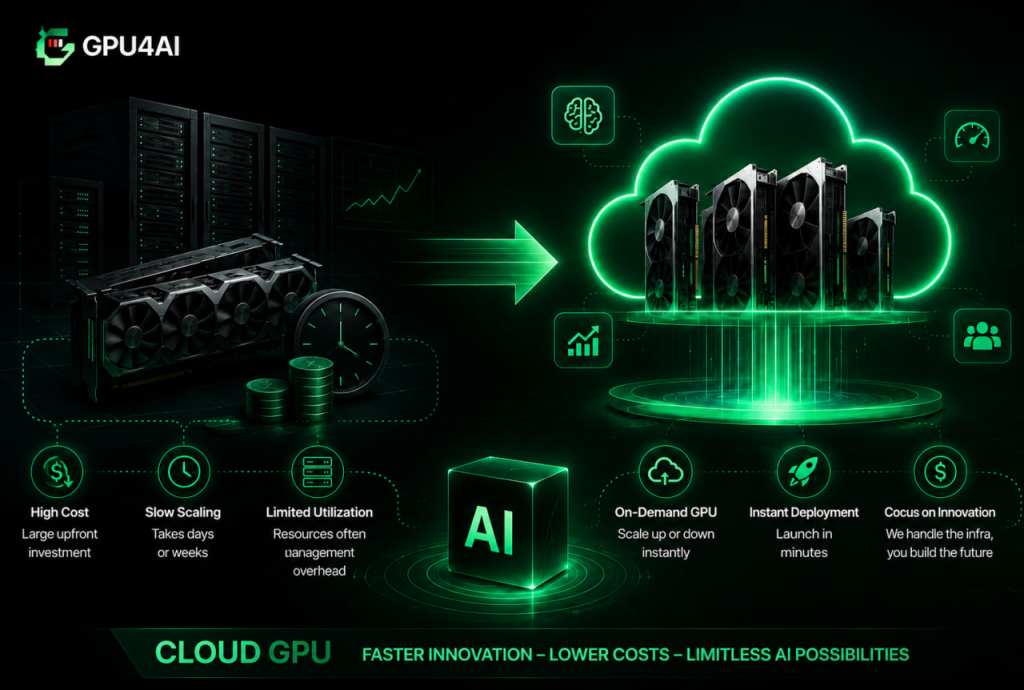
Instead of investing heavily in physical hardware that may sit underutilized for significant portions of its lifecycle, organizations can access GPU resources precisely when they need them. Development teams can scale infrastructure up during intensive training periods and scale down once workloads decrease. The result is greater operational flexibility and significantly improved resource efficiency.
This shift is particularly valuable for AI startups and innovation teams operating in highly competitive markets. The ability to launch infrastructure in minutes rather than weeks allows organizations to move faster, iterate more frequently, and bring products to market sooner. In AI, speed often matters as much as technical excellence. The company that validates an idea first or launches a product first frequently gains a meaningful competitive advantage.
Perhaps the most important impact of Cloud GPU is that it allows engineering teams to focus on what actually creates business value. Instead of spending time managing hardware procurement, maintenance schedules, networking configurations, and capacity planning, developers can focus on model quality, product innovation, and customer outcomes. This shift transforms infrastructure from a bottleneck into an accelerator of innovation.
As AI continues to evolve, organizations that can experiment quickly and deploy efficiently will be positioned to outperform competitors that remain constrained by traditional infrastructure models.
The Economic Advantage of Cloud GPU in the AI Era
Performance is often the first reason organizations explore Cloud GPU, but economics is usually the reason they stay.
One of the most common misconceptions about GPU infrastructure is that hardware acquisition represents the largest cost. In reality, purchasing GPUs is only the beginning. Operating a high-performance computing environment requires substantial ongoing investment in electricity, cooling systems, physical space, maintenance, networking equipment, and specialized personnel. These operational expenses accumulate over time and can significantly exceed initial hardware costs.
Cloud GPU changes this financial model by converting large capital expenditures into flexible operating expenses. Instead of committing significant upfront resources to infrastructure that may become outdated within a few years, organizations can access the latest GPU technologies on demand and pay only for what they use. This approach reduces financial risk while improving agility.
The value of this model becomes even more apparent when considering the pace of innovation in GPU technology. New generations of hardware continue to deliver substantial improvements in performance and efficiency. Organizations that purchase infrastructure outright may find themselves locked into aging hardware while competitors gain access to newer architectures through cloud-based services.
For startups, the advantages are even more compelling. Every dollar invested in infrastructure is a dollar that cannot be spent on product development, customer acquisition, talent recruitment, or market expansion. Cloud GPU allows emerging companies to allocate resources toward growth rather than hardware ownership. This flexibility often extends operational runway and enables faster innovation cycles.
The broader market reflects this trend. Global demand for AI infrastructure continues to accelerate as organizations across industries adopt machine learning, generative AI, computer vision, and autonomous systems. Market analysts consistently project strong growth in AI infrastructure spending throughout the coming decade, driven by increasing demand for scalable compute resources.
Ultimately, Cloud GPU is not simply a technological upgrade. It represents a new operating model for AI development—one that prioritizes flexibility, speed, scalability, and financial efficiency. As AI becomes a core component of business strategy, the ability to access compute resources efficiently may become one of the defining competitive advantages of the next decade.
GPU4AI: A Cloud GPU Platform Built for the Next Generation of AI Builders
As demand for AI infrastructure continues to surge, many organizations face the same challenge: they need access to powerful GPUs, but they do not want the complexity, delays, and costs associated with building their own infrastructure.
Traditional hyperscale cloud providers have undoubtedly accelerated AI adoption. However, they were designed to support a broad range of workloads, from web hosting and databases to enterprise software and analytics. For AI teams, this often means navigating layers of infrastructure management, networking configurations, storage optimization, and pricing structures that were never specifically designed around the realities of modern AI development.
Most AI teams are not looking for another cloud platform.
They are looking for compute.
They want access to powerful GPUs, fast deployment, transparent pricing, and the flexibility to scale resources as projects evolve. More importantly, they want to spend their time building models and products rather than managing infrastructure.
This is the problem GPU4AI was created to solve.
Rather than operating as a traditional cloud provider, GPU4AI functions as a specialized Cloud GPU marketplace and AI infrastructure platform designed specifically for AI builders, startups, research teams, and organizations developing AI-powered products. The platform aggregates GPU resources from a decentralized global network, creating an on-demand compute ecosystem that prioritizes accessibility, speed, and cost efficiency.
The result is a significantly different experience from conventional infrastructure procurement.
Instead of waiting weeks to acquire hardware or navigating complex cloud configurations, users can launch enterprise-grade GPU instances within minutes. Whether the objective is training large language models, running inference workloads, fine-tuning proprietary models, processing large datasets, or deploying AI agents, GPU4AI provides immediate access to the computational resources required to execute those workloads efficiently.
One of the platform’s strongest advantages is access to some of the most powerful GPUs available today. Users can deploy high-performance hardware including NVIDIA H100, H200, B200, A100, RTX 5090, and other advanced GPU architectures designed for AI and high-performance computing workloads. Support for both Linux and Windows environments further simplifies deployment across a wide variety of use cases.
This flexibility becomes increasingly important as AI workloads continue to diversify. A startup building an AI-powered customer support platform may require inference infrastructure optimized for latency. A research organization may need large-scale training clusters. A healthcare company may need secure environments for processing medical imaging data. A creative studio may require rendering infrastructure capable of handling complex 3D production pipelines. Each workload demands different infrastructure characteristics, yet all depend on access to reliable GPU compute.
What makes GPU4AI particularly compelling is its decentralized approach to resource allocation.
The traditional cloud model relies heavily on centralized data centers owned and operated by a small number of providers. While effective, this model often results in capacity constraints, higher operating costs, and pricing structures influenced by infrastructure ownership. GPU4AI takes a different path by leveraging a distributed network of GPU providers around the world. This approach unlocks underutilized compute resources and transforms them into accessible infrastructure for AI teams.
The concept is similar to how platforms like Airbnb transformed hospitality by connecting unused assets with market demand. Instead of empty guest rooms, GPU4AI helps unlock idle GPU capacity and make it available to organizations that need compute resources immediately.
This decentralized architecture can significantly improve cost efficiency while maintaining the scalability required by modern AI applications. According to industry research, infrastructure costs remain one of the largest barriers preventing startups from scaling AI initiatives effectively. Reducing those costs without sacrificing performance can have a direct impact on innovation speed and long-term business sustainability.
Beyond cost savings, the platform is designed around operational simplicity. AI teams can launch resources quickly, monitor usage transparently, and scale infrastructure based on actual demand rather than projected capacity requirements. This flexibility is increasingly valuable as organizations move from experimentation into production environments where usage patterns often fluctuate significantly.
The rise of Agentic AI further reinforces the need for this type of infrastructure. Unlike traditional AI systems that respond to isolated prompts, Agentic AI applications continuously execute tasks, coordinate workflows, interact with multiple systems, and make decisions across complex environments. These workloads require infrastructure that is not only powerful but also highly scalable and available on demand.
As AI evolves from standalone models into intelligent systems capable of orchestrating entire business processes, compute infrastructure will become even more critical. Organizations that can access scalable GPU resources quickly will be positioned to innovate faster, deploy new capabilities sooner, and adapt more effectively to changing market conditions.
GPU4AI is built for that future.
Whether you are training foundation models, deploying AI agents, building generative AI applications, conducting scientific research, or developing enterprise AI solutions, access to the right infrastructure can determine how quickly ideas become products and how efficiently products become businesses.
The Future Belongs to Organizations That Can Access Compute Efficiently
For much of the digital era, data was considered the most valuable strategic asset a company could possess. Today, as artificial intelligence becomes deeply embedded across industries, another asset is emerging as equally important: compute.
Data alone does not create value. Models alone do not create value. Even the most talented AI teams cannot create value if they are constrained by infrastructure that slows experimentation, limits scalability, or makes deployment economically unsustainable. The next wave of competitive advantage will increasingly be determined by how efficiently organizations can transform ideas into working AI systems, and that transformation depends heavily on access to computational resources.
This shift is already visible across the global technology landscape. The world’s largest technology companies are investing hundreds of billions of dollars into AI infrastructure, GPU clusters, and next-generation data centers. These investments are driven by a simple reality: demand for AI compute is growing faster than almost any other category of technology infrastructure.
Yet most organizations cannot build hyperscale infrastructure. Nor should they.
The future of AI infrastructure is unlikely to be defined by ownership. Instead, it will be defined by accessibility. Just as cloud computing transformed software development by eliminating the need to own physical servers, Cloud GPU is transforming AI development by eliminating the need to own expensive GPU hardware.
This democratization of compute is one of the most important developments in the AI economy. It allows startups to compete with larger incumbents, enables research teams to pursue ambitious projects without enormous capital requirements, and gives enterprises the flexibility to scale AI initiatives without committing to infrastructure investments that may become obsolete within a few years.
The implications extend far beyond cost savings. Faster access to compute means faster experimentation. Faster experimentation means more innovation. More innovation ultimately translates into better products, stronger competitive positioning, and greater economic value.
In many ways, compute is becoming the new currency of AI.
Organizations that can access powerful GPU resources at the right time and at the right cost will be positioned to move faster than competitors. They will be able to test more ideas, train better models, deploy new capabilities sooner, and respond more effectively to changing market conditions.
This is precisely why Cloud GPU is no longer simply an infrastructure decision. It is increasingly becoming a strategic business decision.
For AI startups, research organizations, enterprises, and builders creating the next generation of intelligent applications, choosing the right compute platform today may have a lasting impact on growth, innovation, and long-term success.
Frequently Asked Questions
1. When should a company move from on-premise GPUs to Cloud GPU infrastructure?
The answer depends less on company size and more on workload characteristics. Organizations with highly predictable, continuously utilized compute requirements may still benefit from owning hardware. However, most AI projects experience fluctuating demand across experimentation, training, fine-tuning, deployment, and scaling phases. Cloud GPU becomes increasingly attractive when flexibility, rapid deployment, and capital efficiency are priorities. For many organizations, the ability to access enterprise-grade GPUs instantly outweighs the perceived benefits of infrastructure ownership.
2. Why do many AI projects struggle despite having strong models and high-quality data?
Infrastructure is often the hidden bottleneck. Teams may possess exceptional datasets and advanced models, yet still face delays caused by insufficient compute capacity, slow experimentation cycles, or deployment limitations. In competitive markets, the speed at which a team can iterate and validate ideas often matters as much as model accuracy itself. Access to scalable Cloud GPU infrastructure can significantly shorten development cycles and accelerate the path from prototype to production.
3. What matters more in AI: data or compute?
This is often framed as a debate, but in reality the two are complementary. Data provides the raw material from which intelligence is derived, while compute provides the capability to transform that data into useful models and applications. Organizations with vast datasets but inadequate infrastructure frequently struggle to unlock value from their information assets. Likewise, powerful infrastructure without quality data produces limited outcomes. Sustainable AI success depends on balancing data, models, talent, and compute resources.
4. Why are modern AI systems becoming increasingly dependent on GPUs?
The scale of modern AI models has expanded dramatically. Many state-of-the-art systems contain billions of parameters and require immense amounts of parallel computation. GPUs are uniquely optimized for these workloads because they can process thousands of operations simultaneously. This architecture enables significantly faster training and inference compared with traditional CPU-based environments. According to NVIDIA, GPU acceleration is now a foundational component of nearly every major advancement in deep learning and generative AI.
5. How is GPU4AI different from traditional cloud providers?
Traditional cloud providers serve a wide range of computing workloads, from enterprise applications to storage and networking services. GPU4AI is purpose-built for AI teams. The platform focuses specifically on providing rapid access to high-performance GPUs such as NVIDIA H100, H200, B200, A100, and RTX 5090 through a decentralized compute marketplace. By prioritizing AI workloads and leveraging distributed GPU resources, GPU4AI enables organizations to access scalable infrastructure with greater flexibility, transparent pricing, and significantly improved cost efficiency compared with many conventional cloud environments.
Discover on-demand GPU infrastructure for AI teams:
Explore more insights on AI infrastructure, Cloud GPU trends, and AI deployment strategies: