

If data is the raw material that powers artificial intelligence, then GPUs are the engines that transform that data into models capable of creating real-world value. In the early days of AI, when models were relatively small and contained only millions of parameters, CPUs were sufficient for most computational tasks. That reality changed dramatically as deep learning gained momentum and model sizes began growing at an unprecedented pace.
The introduction of the Transformer architecture in 2017 marked a turning point for the industry. It enabled a new generation of AI systems including GPT, Claude, Gemini, and Llama. Unlike traditional machine learning models, these systems learn from enormous datasets and require trillions of mathematical operations during training. As model complexity increases, the demand for computing power grows exponentially alongside it.
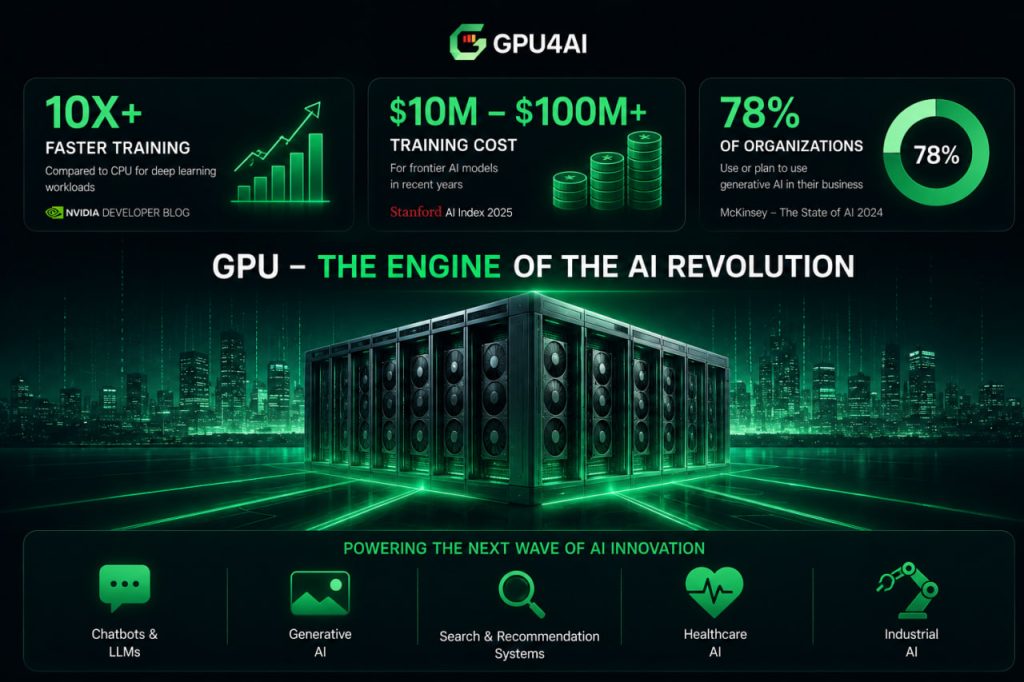
According to the Stanford AI Index Report 2025, training costs for frontier AI models have risen sharply over the past few years. Some leading foundation models now require tens or even hundreds of millions of dollars in compute resources to complete training. This highlights an important reality: AI progress is no longer driven solely by better algorithms. Access to high-performance computing infrastructure has become just as important.
GPU technology emerged as the preferred solution because of its ability to process thousands of operations simultaneously. Unlike CPUs, which are optimized for sequential tasks, GPUs excel at parallel computation. This makes them ideal for matrix operations, which sit at the core of modern neural networks.
Tasks that could take weeks or months on CPUs can often be completed in days or hours using dedicated GPU clusters. This is not merely a performance advantage. In AI development, faster training enables more experimentation, more model iterations, and faster product delivery. The organizations that can test ideas faster often gain a significant competitive advantage.
How GPUs Power Both AI Training and Inference
Many people associate GPUs primarily with AI training, but their importance extends far beyond that stage. Once a model has been trained, it must serve users in real-world applications through a process known as inference.
Every time someone asks a question to a chatbot, generates an image, translates text, or receives a recommendation from an AI system, inference is taking place. These responses need to be delivered within seconds, often to millions of users simultaneously. GPUs provide the computational throughput required to maintain that level of responsiveness.
This is why large-scale AI platforms rely heavily on GPU infrastructure. Services such as conversational AI systems, image generation tools, recommendation engines, and intelligent search platforms all depend on GPUs to deliver real-time performance.
Research from NVIDIA shows that GPUs significantly accelerate both training and inference workloads, making them essential across the entire AI lifecycle. In many commercial applications, inference can ultimately consume more total computing resources than the initial training process itself because it runs continuously after deployment.
As AI adoption expands, organizations are increasingly evaluating infrastructure not only based on training capabilities but also on how efficiently they can scale inference workloads for growing user demand.
The Growing Demand for GPUs Across Every Industry
The need for GPU computing is no longer limited to large technology companies. AI adoption has expanded rapidly across healthcare, finance, manufacturing, retail, logistics, education, and countless other industries.
According to McKinsey’s State of AI Report, the percentage of organizations deploying generative AI in at least one business function has increased significantly over the past two years. As AI becomes a strategic priority, companies of all sizes are competing for access to computational resources that can support development and deployment.
This shift has transformed GPUs into a strategic business asset rather than a niche hardware component. Organizations are increasingly recognizing that competitive advantage comes not only from having better ideas but also from having the ability to train, test, and deploy those ideas faster than competitors.
For startups, GPUs enable rapid experimentation and product iteration. For enterprises, they support large-scale deployment and operational efficiency. Across both groups, access to scalable GPU infrastructure has become a key enabler of AI innovation.
GPU4AI: Making High-Performance AI Infrastructure Accessible
While GPUs are essential for modern AI, building and maintaining GPU infrastructure can be expensive and operationally complex. Purchasing hardware requires significant upfront investment, and organizations must also manage power consumption, cooling systems, maintenance, and future upgrades.
For many AI teams, the more practical solution is accessing GPU resources on demand.
GPU4AI provides scalable GPU infrastructure designed specifically for AI development. Instead of investing in physical hardware, teams can launch high-performance GPU instances within minutes and scale resources based on actual workload requirements.
Whether training large language models, fine-tuning custom datasets, running inference services, or conducting AI research, organizations can access enterprise-grade GPU performance without the burden of infrastructure ownership.
This approach allows teams to focus on building products, improving models, and delivering business value rather than managing hardware.
Frequently Asked Questions
Is a GPU always necessary for AI?
Not always. Small machine learning models can often run effectively on CPUs. However, modern deep learning models, especially large language models and generative AI systems, typically require GPUs to achieve practical training and inference speeds.
Why are GPUs faster than CPUs for AI workloads?
GPUs contain thousands of smaller processing cores designed for parallel computation. Since neural networks rely heavily on matrix calculations that can be executed simultaneously, GPUs deliver significantly higher throughput than CPUs.
Do startups need to buy GPUs?
In most cases, no. Cloud GPU platforms provide access to powerful hardware without requiring large upfront investments. This allows startups to scale resources as their needs evolve.
What is the difference between AI training and AI inference?
Training is the process of teaching a model using large datasets. Inference is the process of using that trained model to generate outputs for real users. Both stages benefit significantly from GPU acceleration.
Will GPU demand continue growing?
Most industry forecasts suggest that demand will continue rising as Generative AI, Agentic AI, multimodal models, and enterprise AI adoption expand across industries
Discover GPU solutions for AI teams at:
Explore more AI infrastructure insights on our blog
————————–
About GPU4AI
GPU4AI is a GPU infrastructure platform built for AI builders, startups, and enterprises that need reliable compute without the complexity of managing hardware.
From model training and inference to AI agents and production workloads, GPU4AI provides on-demand access to enterprise-grade GPU resources designed for modern AI development.
Built with flexibility in mind, GPU4AI helps teams launch faster, scale efficiently, and optimize compute costs without investing in expensive infrastructure upfront.
Whether you’re training large language models, deploying AI applications, or running high-performance inference, GPU4AI delivers the compute foundation needed to move from experimentation to production.
Less time managing infrastructure. More time building AI.
GPU Infrastructure. Simplified for AI.