
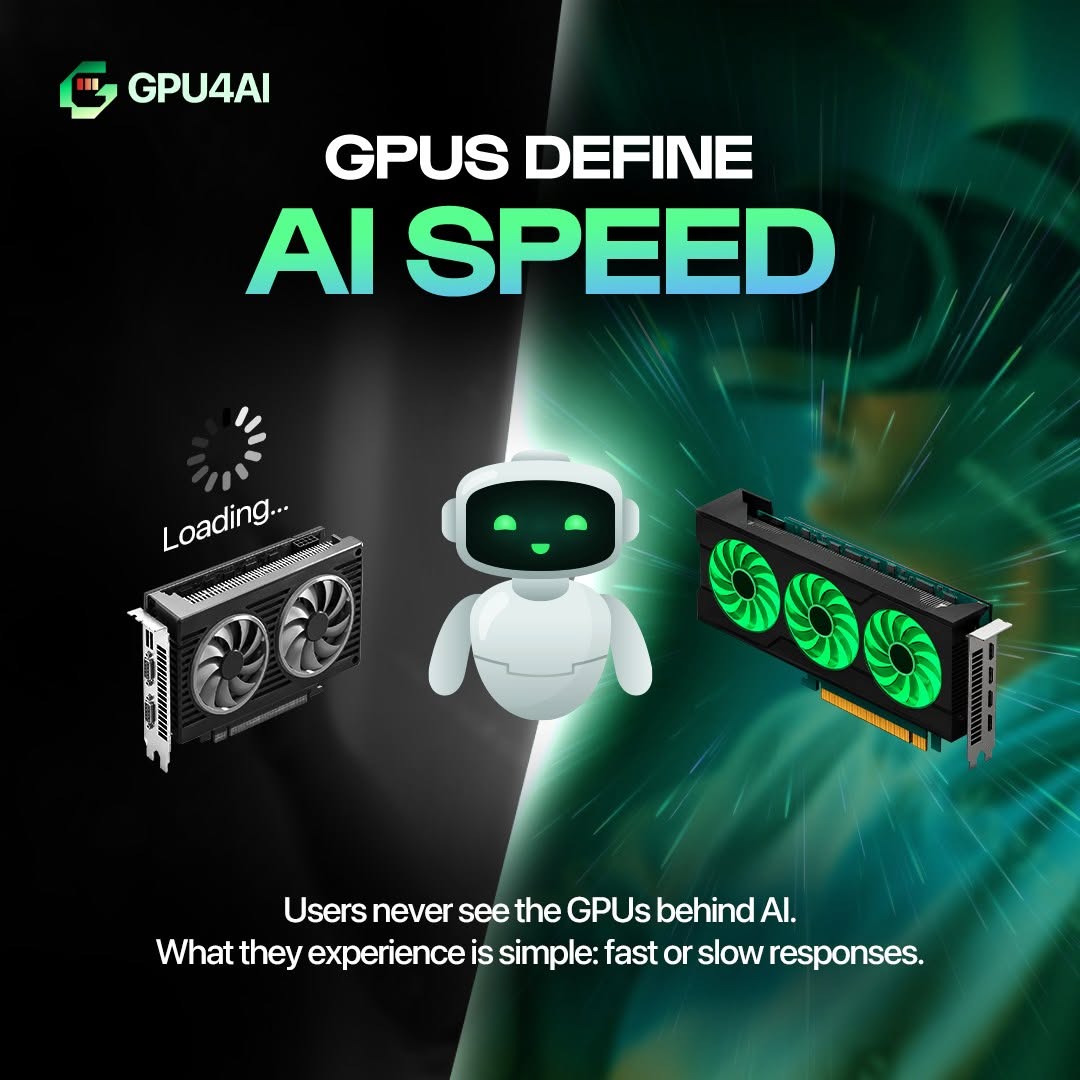

When someone interacts with ChatGPT, generates an image with an AI model, or talks to an AI agent on a website, they rarely think about the hardware powering the experience. What they actually notice is much simpler: does the AI respond instantly, or does it make them wait? A system that produces answers almost immediately feels intelligent and reliable, while even a few seconds of delay can make the experience feel sluggish and frustrating.
Behind every chatbot response, every AI-generated image, and every real-time recommendation lies an enormous amount of computation. Millions—or even billions—of mathematical operations must be executed before the system can produce the next token, render the next pixel, or complete the next task. The component responsible for handling this workload is the GPU.
According to NVIDIA’s guide on large language model inference optimization, GPU performance directly influences throughput, latency, and the ability to process multiple requests simultaneously. These three factors ultimately determine the quality of the user experience delivered by AI applications.
As AI becomes deeply integrated into customer service platforms, enterprise software, productivity tools, and consumer applications, response speed is no longer just a technical metric. It has become a competitive advantage that affects user satisfaction, engagement, and business outcomes.
Does A More Powerful GPU Always Mean Faster AI Responses?
Many people assume that upgrading to a better AI model is the primary way to improve response speed. In reality, that is only part of the equation. Once a model has been trained, every interaction with users happens during the inference stage, where the GPU performs continuous matrix multiplications across billions of parameters to generate tokens or images in real time.
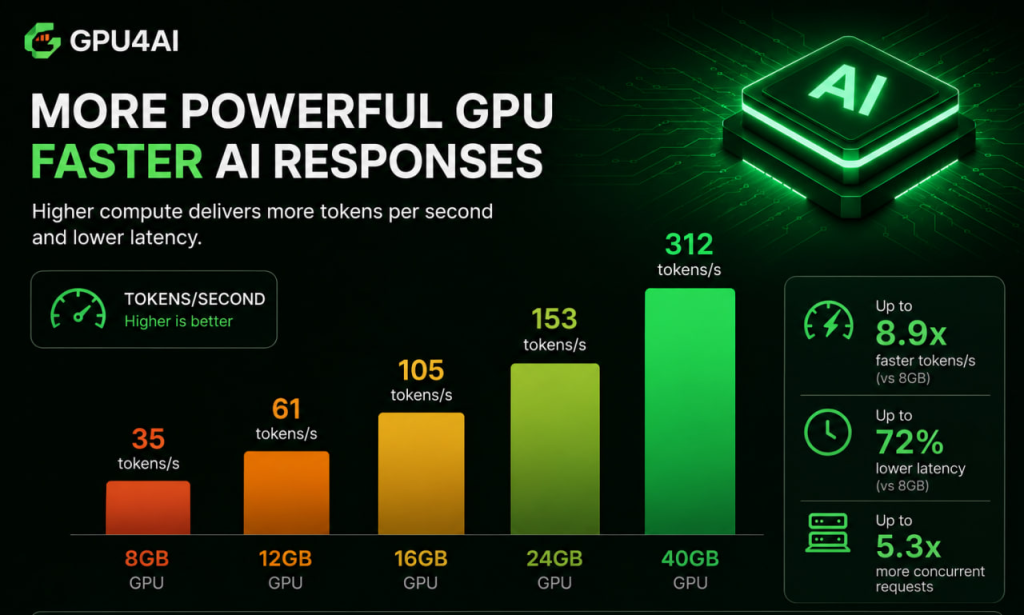
When the GPU has sufficient computational power and memory bandwidth, inference can be completed extremely quickly, creating an almost instantaneous experience for users. However, if compute resources become saturated or insufficient, token generation slows down, latency increases, and response times become noticeably longer.
This is why the same language model can deliver dramatically different user experiences depending on the infrastructure behind it. On a high-performance GPU, it may generate hundreds of tokens per second, while on less capable hardware the exact same model may operate at only a fraction of that speed.
Low Latency Is More Than An Engineering Goal—It’s A Business Advantage
For commercial AI products, low latency is just as important as model accuracy. Even if an AI system produces excellent answers, users may still perceive it as inferior if every interaction requires several seconds of waiting.
This becomes especially critical for AI agents, customer support assistants, enterprise chatbots, and real-time content generation platforms. When thousands of users submit requests simultaneously, GPU infrastructure must not only process each request quickly but also maintain consistent performance under heavy load. Without sufficient compute resources, latency increases rapidly and bottlenecks begin to appear across the system.
From a business perspective, reducing latency by even a few hundred milliseconds can significantly improve customer satisfaction, retention rates, and overall engagement. This is why many organizations now view GPU infrastructure not simply as IT spending but as a direct investment in product quality and competitive differentiation.
GPU4AI – Building GPU Infrastructure That Keeps AI Fast and Scalable
For many organizations developing AI-powered products, choosing the right model is only half of the challenge. The other half is ensuring that the underlying infrastructure can consistently deliver low latency as user demand grows.
In practice, many AI applications perform well during testing with only a small number of users but begin to experience increasing response times once they are deployed to production. As concurrent requests rise into the hundreds or thousands, GPU resources can become saturated, causing latency to spike and overall user experience to decline. In these situations, the problem is often not the model itself but the compute infrastructure supporting it.
Cloud GPU infrastructure addresses this challenge by allowing resources to scale dynamically with workload demand. When traffic increases, additional GPU capacity can be provisioned to maintain consistent performance. When demand decreases, resources can be released immediately, helping organizations optimize operating costs without sacrificing responsiveness.
GPU4AI is designed around this flexible approach. By providing access to high-performance GPU infrastructure on demand, businesses can deploy chatbots, AI agents, generative AI applications, and large-scale inference services without investing in expensive on-premise hardware. Instead of spending valuable engineering time managing servers and infrastructure, development teams can focus on improving models, building products, and delivering better user experiences.
Frequently Asked Questions
1. Does GPU performance directly affect AI response speed?
Yes. After an AI model has been trained, every user interaction relies on the inference process, which is executed primarily on GPUs. A more capable GPU can process computations faster, resulting in higher token generation rates and lower response latency.
2. Why can the same AI model respond at different speeds on different platforms?
Model architecture is only one part of the equation. Real-world performance also depends on GPU compute power, VRAM capacity, memory bandwidth, inference optimization techniques, and the overall deployment architecture. Two services using the same model may deliver completely different user experiences because of differences in their infrastructure.
3. Why is low latency so important for AI products?
Modern users expect AI assistants and chatbots to respond almost instantly. Even delays of a few hundred milliseconds can reduce perceived quality, lower engagement, and negatively affect customer satisfaction. At production scale, latency becomes a business metric as much as a technical one.
4. Does a more powerful GPU always guarantee faster AI?
Not necessarily. Actual performance depends on multiple factors, including model optimization, VRAM availability, context length, batch size, and software configuration. However, under comparable conditions, GPUs with greater compute capabilities generally provide significantly faster inference performance.
5. Should AI startups invest in physical GPU servers from the beginning?
For most early-stage companies, Cloud GPU infrastructure offers greater flexibility. Instead of committing large amounts of capital to hardware sized for peak demand, startups can scale compute resources as their products evolve, reduce upfront investment, and gain access to the latest GPU generations without hardware replacement cycles.
Discover GPU solutions for AI teams at:
Explore more AI infrastructure insights on our blog
————————–
About GPU4AI
GPU4AI is a GPU infrastructure platform built for AI builders, startups, and enterprises that need reliable compute without the complexity of managing hardware.
From model training and inference to AI agents and production workloads, GPU4AI provides on-demand access to enterprise-grade GPU resources designed for modern AI development.
Built with flexibility in mind, GPU4AI helps teams launch faster, scale efficiently, and optimize compute costs without investing in expensive infrastructure upfront.
Whether you’re training large language models, deploying AI applications, or running high-performance inference, GPU4AI delivers the compute foundation needed to move from experimentation to production.
Less time managing infrastructure. More time building AI.
GPU Infrastructure. Simplified for AI.