

AI image generation has evolved from a research experiment into a practical business tool. Companies now use generative AI to create marketing assets, product mockups, advertising creatives, concept art, and personalized visual content at a scale that would have been impossible just a few years ago.
Models such as Stable Diffusion and FLUX have dramatically lowered the barrier to entry, allowing startups and enterprises to build their own text-to-image systems instead of relying solely on third-party APIs. However, while much of the attention is focused on model quality, production success often depends on something less visible: GPU infrastructure.
An image generation platform is not simply an AI model wrapped inside a web interface. It requires sufficient VRAM, stable inference performance, concurrent request handling, and the ability to scale resources as user demand grows. Without the right compute layer, even the best model can become slow, expensive, and unreliable in production.
Why GPU Infrastructure Is Just as Important as the Model
When people evaluate AI image generators, they usually compare prompt quality, realism, or artistic style. In reality, those factors represent only one side of the equation. The infrastructure behind the model determines how quickly users receive results and how many requests the system can process simultaneously.
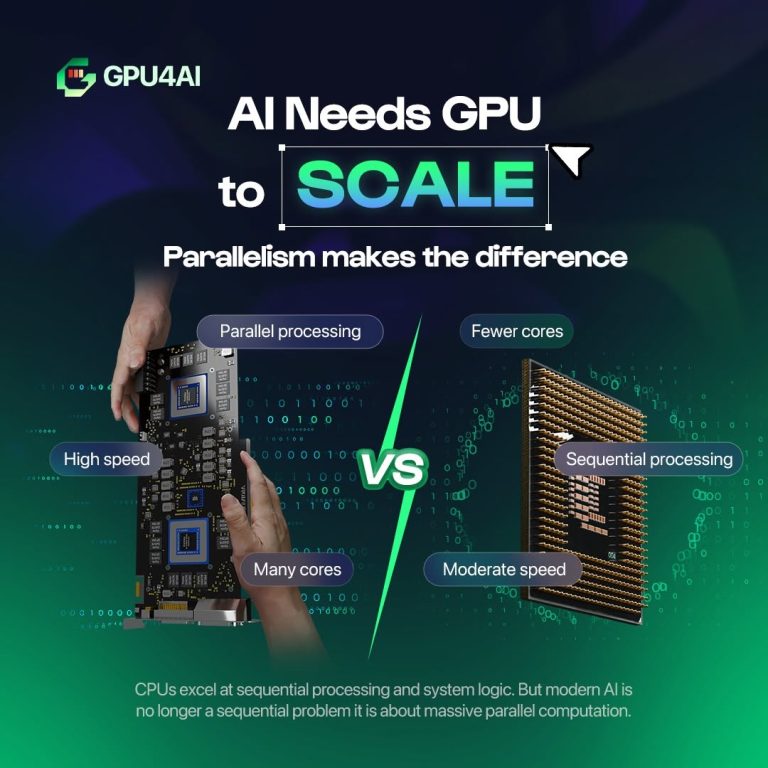
Diffusion-based models repeatedly execute billions of mathematical operations during inference. According to the Hugging Face Diffusers documentation, GPU acceleration is essential for practical image generation because these workloads are highly parallel and computationally intensive.
The amount of available VRAM directly affects the maximum image resolution, batch size, and model compatibility. Larger memory pools allow more complex workflows while reducing the need for memory swapping that can dramatically slow inference.
In practice, AI image generation performance depends on both the model architecture and the compute environment supporting it.
From Experimentation to Production: Scaling AI Image Generation
Many teams successfully run Stable Diffusion on a single workstation during early development but encounter bottlenecks when moving to production.
A real-world AI image platform must continuously process requests from multiple users while maintaining predictable latency. If compute resources become saturated, queues grow longer, response times increase, and the overall user experience deteriorates.

According to NVIDIA’s AI infrastructure guidance, GPU clusters enable organizations to serve larger AI workloads through parallel processing and elastic scaling rather than relying on fixed hardware capacity.
Cloud-based GPU infrastructure addresses these challenges by allowing teams to allocate resources dynamically. During traffic spikes, additional GPUs can be provisioned immediately. When demand decreases, unused resources can be released to optimize operating costs.
This flexibility is especially valuable for startups where user growth is difficult to predict and infrastructure investments need to remain efficient.
GPU4AI Helps You Build AI Image Generation at Scale
GPU4AI provides GPU infrastructure designed specifically for modern AI workloads, including image generation pipelines powered by Stable Diffusion, FLUX, and other diffusion-based models.
Instead of purchasing expensive hardware upfront, teams can access high-performance GPUs on demand, scale resources according to workload requirements, and maintain predictable inference performance throughout deployment.
For organizations building AI-powered design platforms, creative automation tools, marketing applications, or custom image generation services, optimized GPU infrastructure becomes a competitive advantage rather than just a technical requirement.
With GPU4AI, developers can spend more time improving models and user experience while relying on scalable compute infrastructure that grows alongside their products.
Frequently Asked Questions
Can I build an AI image generator without owning GPUs?
Yes. Cloud GPU platforms allow developers to deploy Stable Diffusion or FLUX models without investing in dedicated hardware, making experimentation and production significantly more accessible.
Why is VRAM important for image generation?
VRAM determines how much model data and intermediate computation can remain in GPU memory. Larger VRAM generally enables higher resolutions, larger batches, and smoother inference performance.
Is model quality more important than GPU performance?
Both matter. A strong model produces better images, but insufficient GPU resources can increase latency, reduce throughput, and negatively affect user experience regardless of model quality.
Which workloads benefit most from GPU4AI?
GPU4AI is well suited for Stable Diffusion deployments, FLUX inference, AI creative tools, automated design pipelines, marketing content generation systems, and enterprise-scale image generation platforms.
Discover GPU solutions for AI teams at:
Explore more AI infrastructure insights on our blog
————————–
About GPU4AI
GPU4AI is a GPU infrastructure platform built for AI builders, startups, and enterprises that need reliable compute without the complexity of managing hardware.
From model training and inference to AI agents and production workloads, GPU4AI provides on-demand access to enterprise-grade GPU resources designed for modern AI development.
Built with flexibility in mind, GPU4AI helps teams launch faster, scale efficiently, and optimize compute costs without investing in expensive infrastructure upfront.
Whether you’re training large language models, deploying AI applications, or running high-performance inference, GPU4AI delivers the compute foundation needed to move from experimentation to production.
Less time managing infrastructure. More time building AI.
GPU Infrastructure. Simplified for AI.