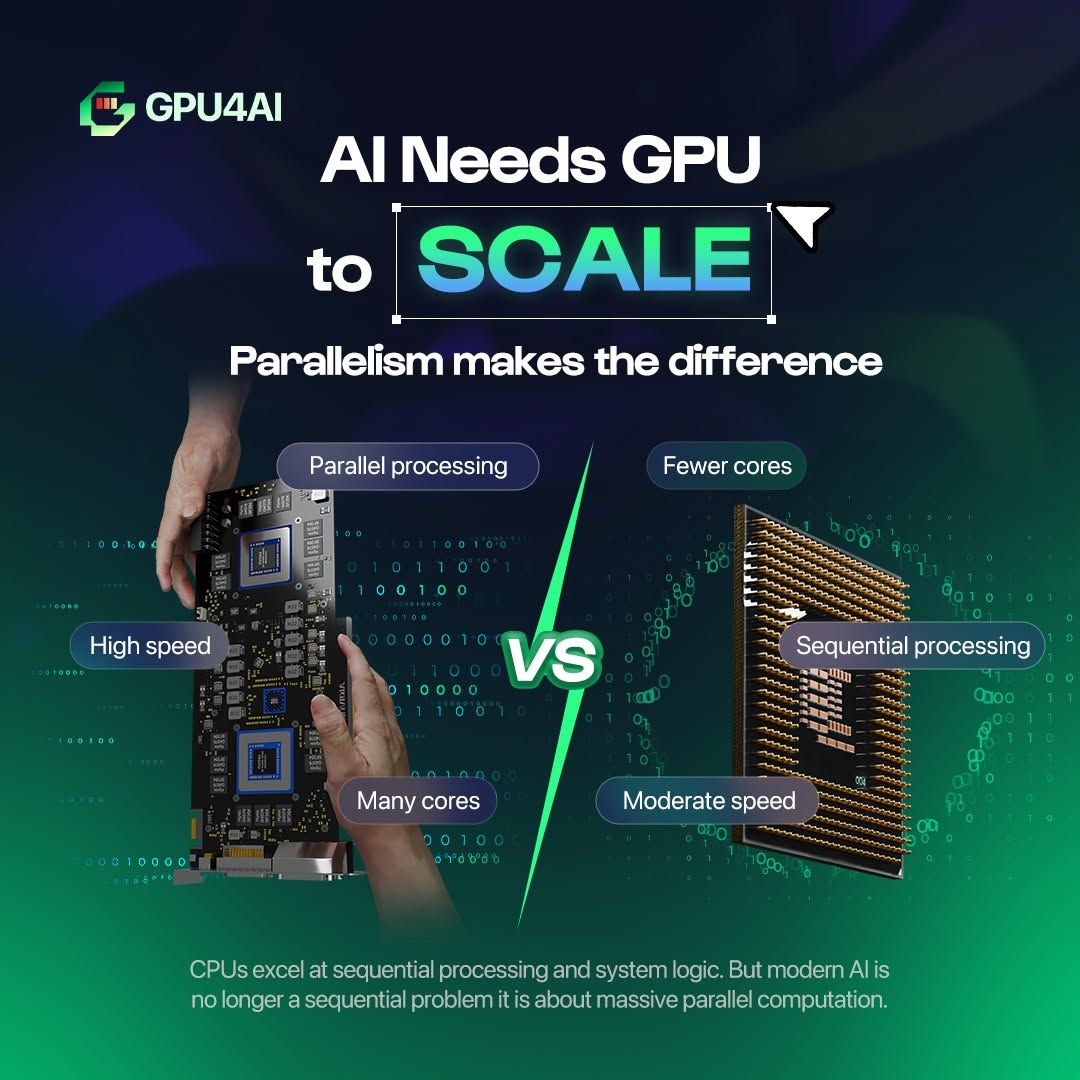

For decades, CPUs have been the foundation of almost every computing system. Their architecture is designed to execute sequential instructions efficiently, making them ideal for operating systems, enterprise applications, databases, and general-purpose computing. However, as artificial intelligence has evolved, the nature of computational workloads has changed dramatically.
Modern AI models no longer perform a handful of isolated calculations. Instead, they process millions or even billions of mathematical operations simultaneously during training and inference. Large language models such as GPT and Llama, as well as image generation systems like Stable Diffusion and FLUX, rely heavily on massive matrix multiplications that can be executed in parallel. This is exactly the type of workload GPUs were designed to handle.
Unlike CPUs, which typically contain a relatively small number of powerful cores optimized for sequential execution, GPUs consist of thousands of smaller processing cores capable of performing identical operations across enormous datasets at the same time. This parallel architecture allows GPUs to accelerate deep learning tasks that would otherwise take significantly longer on conventional processors.
As AI models continue to grow in size and complexity, the difference between CPUs and GPUs becomes increasingly significant. CPUs remain essential for orchestrating applications and managing system resources, but GPUs are the component that ultimately determines whether AI workloads can scale efficiently.
GPUs Do Not Replace CPUs, They Enable AI to Scale
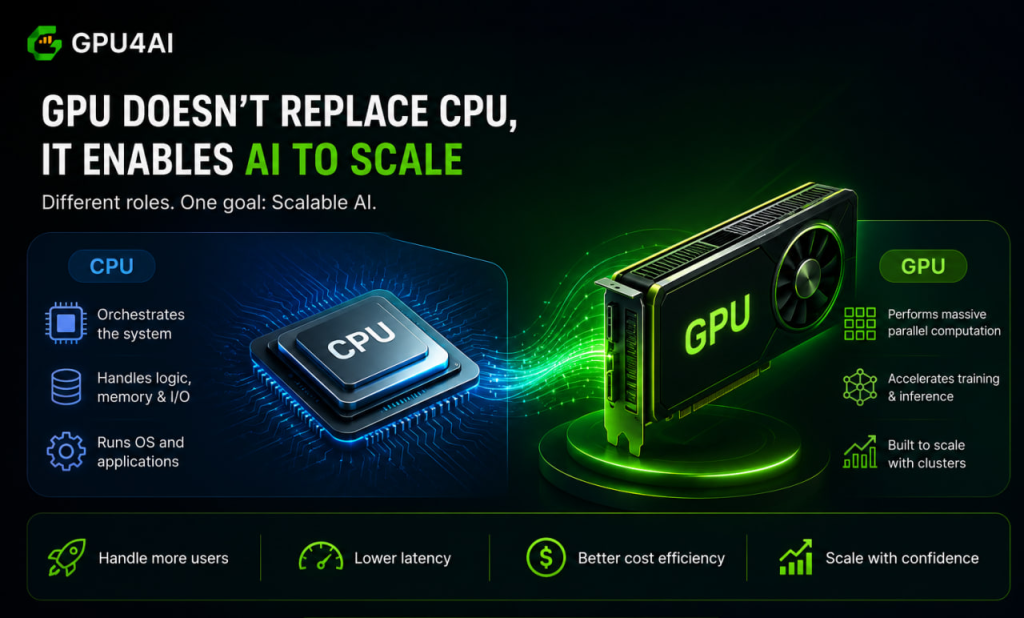
A common misconception is that GPUs will eventually replace CPUs in AI systems. In reality, these two types of processors serve very different purposes and complement rather than compete with each other. CPUs remain responsible for orchestrating the entire system, handling operating system processes, business logic, memory management, networking, and communication with storage devices. GPUs, by contrast, are dedicated to the most computationally intensive part of AI: executing millions of parallel mathematical operations required for model training and inference.
This distinction becomes increasingly apparent as AI workloads grow. A chatbot serving only a few dozen users may still operate acceptably on modest hardware, but when traffic expands to thousands or even millions of requests per day, CPUs quickly become a bottleneck if they are expected to perform deep learning computations. GPUs are specifically designed to scale horizontally, allowing multiple devices to work together on the same model or distribute workloads across clusters while maintaining consistent performance and low latency.
Google Cloud also notes that pairing AI workloads with GPU-accelerated infrastructure significantly improves throughput and reduces latency for real-time applications. As organizations transition from proof-of-concept projects to production systems, the critical challenge is no longer whether a model can run, but whether it can reliably serve thousands of concurrent users while maintaining acceptable costs and user experience.
For this reason, GPUs should not be viewed as replacements for CPUs. Instead, they are the key component that enables AI systems to scale. CPUs coordinate and manage applications, while GPUs provide the massive computational power required to transform billion-parameter models into production-ready services capable of supporting real-world demand.
GPU4AI Helps Businesses Scale AI from Experimentation to Production
Not every company needs to invest in a dedicated GPU cluster from day one to build successful AI products. In many situations, what matters more is having access to the right amount of computing power at the right time and being able to scale resources as demand increases.
GPU4AI is designed to solve this challenge by providing GPU infrastructure optimized for modern AI workloads, including model training, fine-tuning, and inference. Instead of making a large upfront investment in physical hardware, businesses can provision GPU resources that match their current requirements and expand seamlessly as their AI products evolve from early experiments into production deployments.
This flexible approach enables startups and enterprises to accelerate development while minimizing infrastructure risk. Engineering teams can focus on improving models, testing new ideas, and delivering better user experiences without spending months managing hardware procurement or building complex compute environments.
With support for workloads such as Large Language Models, Stable Diffusion, FLUX, and other generative AI applications, GPU4AI provides the scalable compute foundation needed to grow AI products efficiently while keeping costs under control.
FAQ
What is the main difference between a GPU and a CPU for AI?
A CPU is designed for sequential processing and system management, making it ideal for operating systems and business logic. A GPU, on the other hand, contains thousands of processing cores optimized for parallel computation, allowing it to execute the massive matrix operations required by modern AI models much more efficiently.
Why do modern AI systems rely on GPUs?
Training and running today’s AI models involve billions of mathematical operations that must be executed simultaneously. GPUs are specifically built for this type of parallel workload, significantly reducing both training time and inference latency compared to CPU-only systems.
Can AI models run without a GPU?
Yes, many AI models can technically run on CPUs. However, for large language models, image generation systems, or production-scale inference, CPU performance is often insufficient. GPUs provide the compute power necessary to achieve practical response times and support large numbers of concurrent users.
Does a GPU completely replace a CPU?
No. CPUs and GPUs have complementary roles. CPUs coordinate applications, manage memory, and handle system-level operations, while GPUs accelerate the computationally intensive tasks involved in AI training and inference.
Who should use GPU4AI?
GPU4AI is designed for AI startups, enterprises, research teams, and developers who need scalable GPU infrastructure for model training, fine-tuning, inference, Stable Diffusion, FLUX, Large Language Models, and other compute-intensive AI workloads without investing heavily in their own hardware.
Discover GPU solutions for AI teams at:
Explore more AI infrastructure insights on our blog
————————–
About GPU4AI
GPU4AI is a GPU infrastructure platform built for AI builders, startups, and enterprises that need reliable compute without the complexity of managing hardware.
From model training and inference to AI agents and production workloads, GPU4AI provides on-demand access to enterprise-grade GPU resources designed for modern AI development.
Built with flexibility in mind, GPU4AI helps teams launch faster, scale efficiently, and optimize compute costs without investing in expensive infrastructure upfront.
Whether you’re training large language models, deploying AI applications, or running high-performance inference, GPU4AI delivers the compute foundation needed to move from experimentation to production.
Less time managing infrastructure. More time building AI.
GPU Infrastructure. Simplified for AI.