
Artificial intelligence has fundamentally changed how organizations consume computing resources. A few years ago, building an AI product often meant investing heavily in dedicated servers, purchasing expensive GPUs, and maintaining an internal infrastructure team. Today, however, that model is rapidly being replaced by a far more flexible approach: hourly GPU rental.
For many AI teams, owning hardware is no longer the competitive advantage. The real advantage comes from being able to access the latest GPU resources instantly, scale them up or down depending on workload, and pay only for what is actually used. This shift is particularly important as modern AI development becomes increasingly iterative, requiring continuous experimentation, model fine-tuning, inference, and deployment.
The economics behind this transformation are straightforward. Purchasing enterprise GPUs requires significant upfront capital expenditure, while technology cycles continue to shorten with every new NVIDIA release. A GPU purchased today may become less competitive within just a few years, yet the financial commitment remains fixed.
At the same time, utilization rates are rarely constant. Development teams often need enormous computing capacity during training phases but only a fraction of that power during testing or production. Maintaining dedicated infrastructure for peak demand results in expensive idle hardware for much of the project lifecycle.
This is why more organizations are moving toward on-demand GPU infrastructure. Instead of treating computing as a fixed asset, they increasingly view it as an elastic service that adapts to business needs.
Why Traditional GPU Ownership Is Becoming Less Attractive
The rapid pace of AI innovation has exposed the limitations of buying and operating physical GPU infrastructure. Every stage of an AI product—from data preparation and model training to inference and monitoring—requires different levels of computational power.
Organizations that invest in their own servers must plan capacity years in advance, often overestimating future demand to avoid shortages. As a result, expensive hardware sits underutilized while still generating electricity, cooling, maintenance, and operational costs.
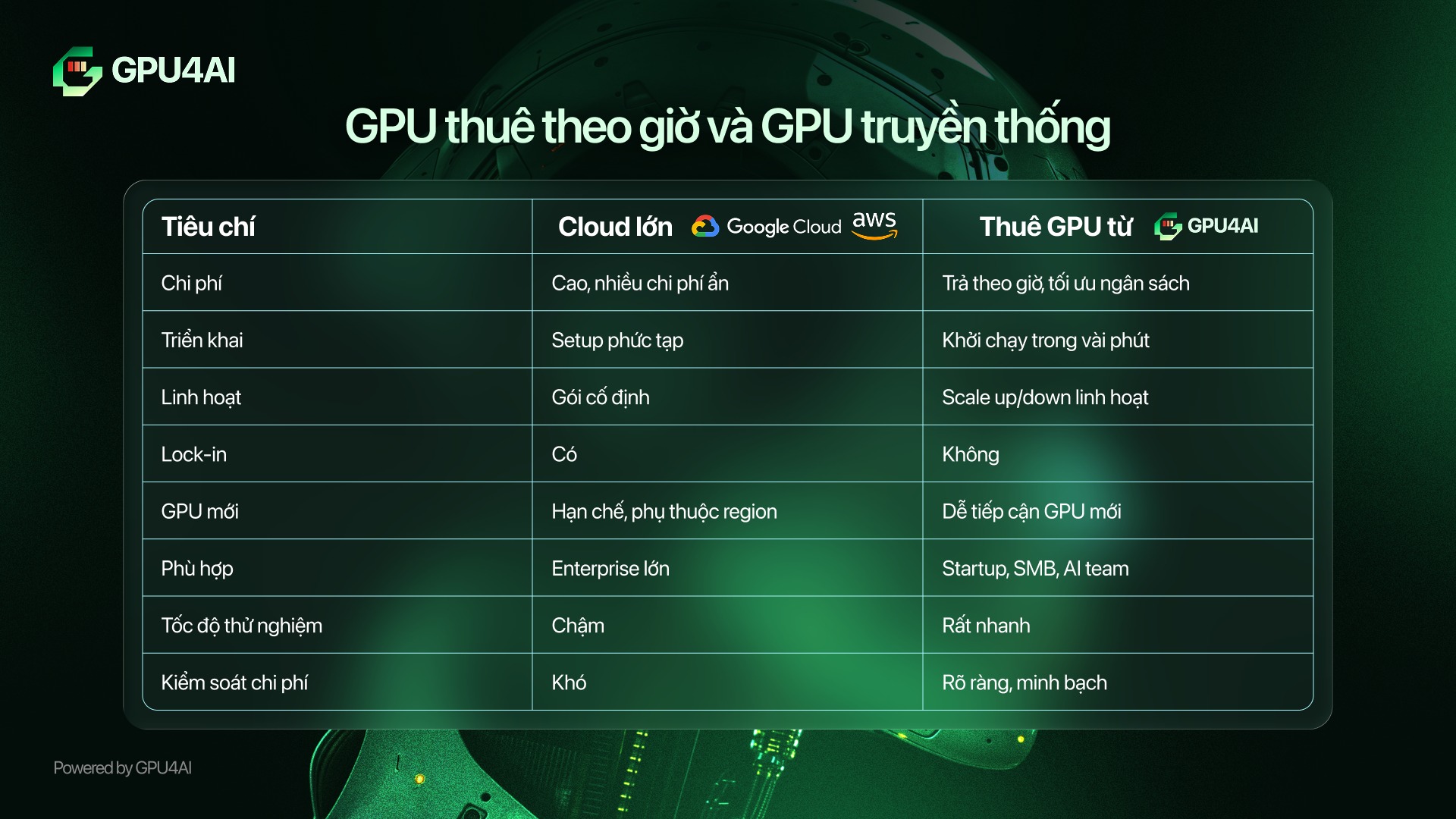
Large cloud providers solve part of this problem but often introduce another challenge: pricing complexity. Different regions, reservation models, hidden networking costs, and premium charges for newer GPU generations can make budgeting difficult, especially for startups and growing AI companies.
This is where hourly GPU rental creates a meaningful alternative. Teams can provision infrastructure only when needed, terminate resources immediately after workloads finish, and avoid long-term hardware commitments altogether.
The Real Advantages of Hourly GPU Rental
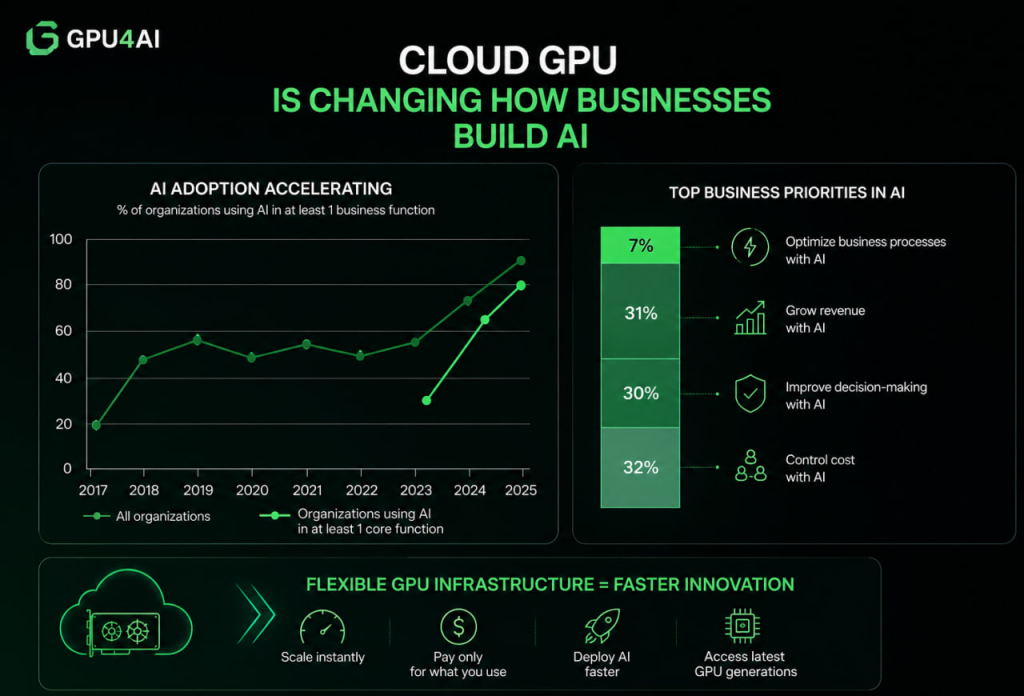
The appeal of hourly GPU rental extends beyond lower costs. Its biggest advantage lies in flexibility, allowing AI teams to match computing resources precisely with the lifecycle of their projects instead of being constrained by fixed infrastructure.
During the early stages of development, a startup may only need a single GPU to validate an idea or train a proof-of-concept model. As the product matures and datasets grow larger, additional GPUs can be provisioned immediately without purchasing new hardware or expanding server capacity. Once the training job is complete, those resources can be released just as quickly, ensuring that organizations only pay for active compute time.
This elastic model significantly improves capital efficiency. Rather than locking large amounts of budget into depreciating hardware assets, businesses can redirect investment toward hiring engineers, collecting higher-quality data, or accelerating product development.
Deployment speed is another major benefit. Procuring enterprise hardware often takes weeks or even months when accounting for purchasing processes, shipping delays, installation, networking, and software configuration. By contrast, modern cloud GPU platforms enable developers to launch production-ready GPU instances within minutes.
The ability to access the latest GPU generations also plays an increasingly important role. AI models continue to grow in size and complexity, while NVIDIA regularly introduces more capable architectures that deliver substantial performance improvements. Organizations relying on owned infrastructure may remain tied to older hardware for years due to depreciation cycles, whereas on-demand rental allows teams to adopt newer GPUs immediately as they become available.
For globally distributed engineering organizations, hourly GPU rental also simplifies collaboration. Developers, researchers, and machine learning engineers can access identical computing environments regardless of location, reducing configuration inconsistencies and improving reproducibility across projects.
Common Use Cases for Hourly GPU Infrastructure
The versatility of hourly GPU services makes them suitable for nearly every stage of the AI development lifecycle.
Large Language Model (LLM) training and fine-tuning represent one of the most computationally demanding workloads. Even organizations working with open-source models often require powerful multi-GPU environments for parameter optimization and domain adaptation.
Generative AI applications—including image generation, video synthesis, and multimodal content creation—also benefit significantly from scalable GPU infrastructure. Workloads fluctuate depending on user demand, making pay-as-you-go resources particularly attractive.
High-performance inference is another rapidly growing use case. AI-powered assistants, recommendation systems, and real-time analytics platforms require low-latency responses while serving thousands or even millions of requests simultaneously. Elastic GPU allocation enables these systems to scale dynamically without maintaining excessive idle capacity.
Research institutions and enterprise innovation teams similarly leverage hourly GPU rental for experimentation. Instead of waiting for internal infrastructure availability, researchers can provision dedicated environments immediately, accelerating scientific discovery and shortening development cycles.
Beyond AI, GPU infrastructure also supports 3D rendering, simulation workloads, scientific computing, computational biology, and advanced data analytics, making it a valuable resource across multiple industries.
GPU4AI: Built for Teams That Need AI Compute on Demand
At GPU4AI, we believe AI builders should focus on creating intelligent products rather than managing hardware infrastructure.
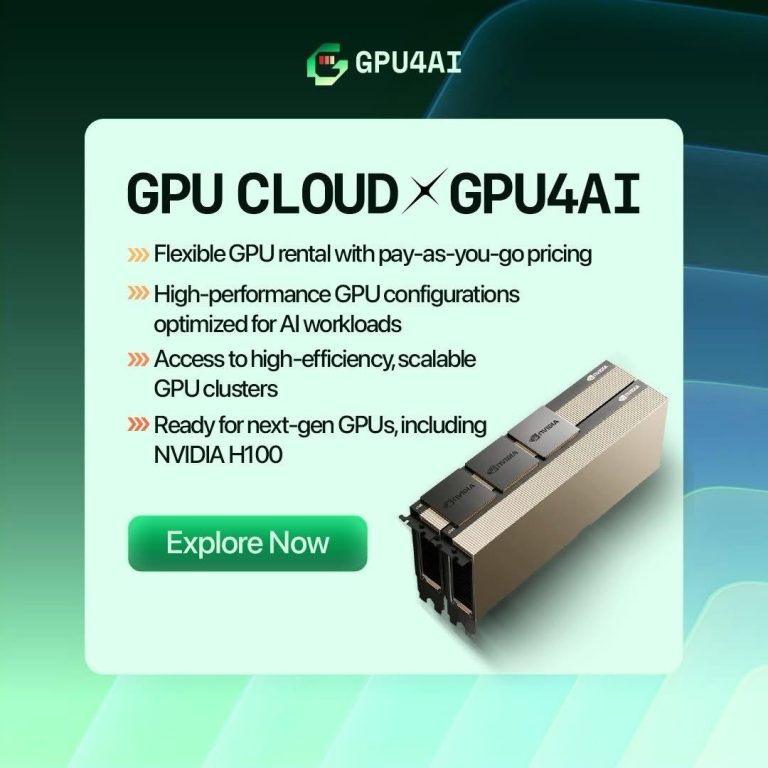
GPU4AI provides instant access to enterprise-grade GPUs—including NVIDIA H100, H200, B200, A100, RTX 5090, and other high-performance accelerators—through a decentralized marketplace designed for flexibility and cost efficiency. Both Linux and Windows environments are fully supported, allowing teams to launch production-ready instances in minutes instead of weeks.
Because GPU4AI aggregates computing resources from a distributed network rather than relying solely on centralized data centers, customers can often achieve significantly lower costs compared with traditional hyperscale cloud providers while maintaining access to cutting-edge hardware.
Whether you are training large language models, running production inference pipelines, developing generative AI applications, or scaling enterprise machine learning systems, GPU4AI enables your team to provision compute resources precisely when needed and release them when workloads finish.
Instead of investing in infrastructure that may sit idle, organizations can adopt a usage-based model that aligns technology spending directly with business growth.
FAQ
1. Is hourly GPU rental suitable for enterprise AI projects?
Yes. Many enterprises now combine internal infrastructure with cloud-based GPU resources to handle peak workloads, accelerate experimentation, and reduce capital expenditure. Hybrid deployment strategies have become increasingly common as AI adoption scales across industries.
2. When is buying GPUs a better option than renting?
Owning GPUs may make sense for organizations running highly predictable, 24/7 workloads with consistently high utilization over multiple years. However, for startups, research teams, and businesses with fluctuating demand, hourly rental is often significantly more cost-effective and operationally flexible.
3. Can hourly GPU rental support large language model training?
Absolutely. Modern cloud GPU platforms provide access to high-end accelerators capable of training and fine-tuning large language models, diffusion models, and multimodal AI systems. Performance depends on the GPU configuration selected and the distributed training strategy used.
4. Why are many AI startups choosing on-demand GPU infrastructure?
AI startups typically prioritize speed over ownership. Renting GPUs eliminates procurement delays, reduces upfront investment, and enables teams to experiment rapidly while preserving cash for product development and market expansion.
5. How does GPU4AI differentiate itself from traditional cloud providers?
GPU4AI combines enterprise-grade GPU access with a decentralized marketplace model that offers fast deployment, transparent pricing, flexible scaling, and significantly lower infrastructure costs for many AI workloads. Instead of locking users into long-term commitments, the platform enables compute resources to scale dynamically according to actual business needs.
Discover GPU solutions for AI teams at:
Explore more AI infrastructure insights on our blog
————————–
About GPU4AI
GPU4AI is a GPU infrastructure platform built for AI builders, startups, and enterprises that need reliable compute without the complexity of managing hardware.
From model training and inference to AI agents and production workloads, GPU4AI provides on-demand access to enterprise-grade GPU resources designed for modern AI development.
Built with flexibility in mind, GPU4AI helps teams launch faster, scale efficiently, and optimize compute costs without investing in expensive infrastructure upfront.
Whether you’re training large language models, deploying AI applications, or running high-performance inference, GPU4AI delivers the compute foundation needed to move from experimentation to production.
Less time managing infrastructure. More time building AI.
GPU Infrastructure. Simplified for AI.