
AI in healthcare is no longer an emerging technology waiting for adoption. It is rapidly becoming one of the foundational pillars of modern healthcare systems, influencing everything from diagnostics and clinical decision-making to hospital operations and medical research. What makes this transformation particularly significant is not simply the growing sophistication of AI models, but the unprecedented volume of healthcare data being generated across the world. Hospitals, research institutions, pharmaceutical companies, and healthcare technology providers are collectively producing more information than ever before, yet much of that data remains underutilized because traditional methods of analysis cannot keep pace with its scale and complexity.
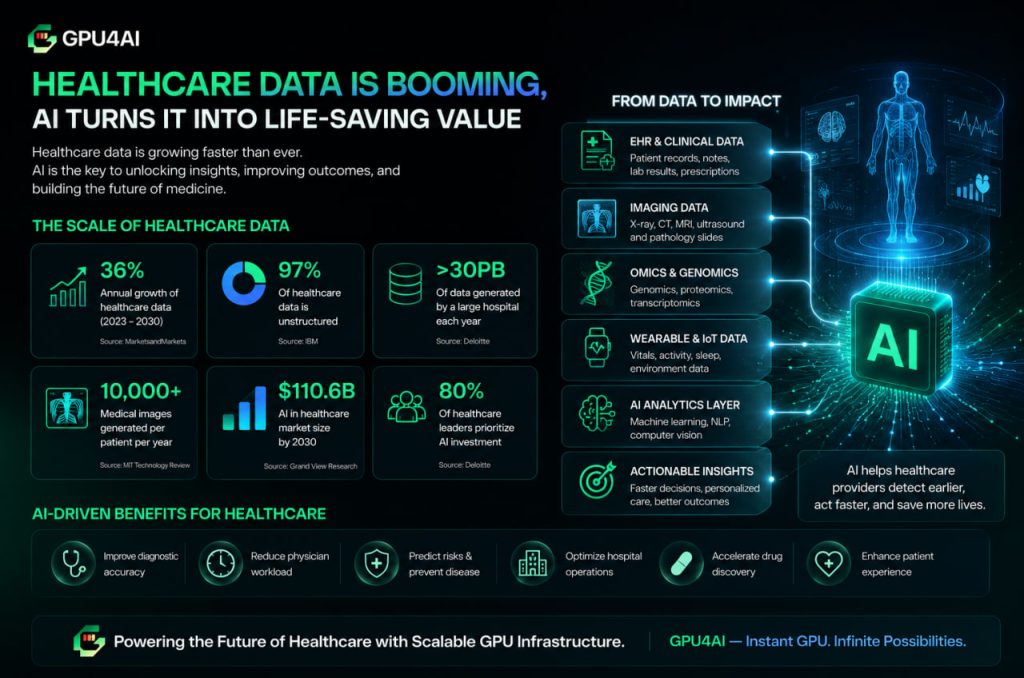
The healthcare industry is facing a combination of challenges that few other sectors experience simultaneously. Aging populations continue to increase demand for healthcare services, while workforce shortages place growing pressure on medical professionals. At the same time, advances in genomics, medical imaging, wearable devices, and electronic health records have created a flood of data that requires continuous analysis. Healthcare organizations are no longer struggling to collect information; they are struggling to extract meaningful insights from it quickly enough to improve patient outcomes and operational efficiency.
Artificial intelligence has emerged as one of the most promising solutions to this challenge. Rather than replacing healthcare professionals, AI is increasingly being deployed to augment human expertise by identifying patterns, surfacing insights, automating repetitive tasks, and enabling more informed decisions. According to McKinsey, more than 80% of healthcare organizations have already implemented at least one AI use case for end users, while nearly half have integrated generative AI into operational workflows. These figures indicate that AI adoption has moved beyond experimentation and is becoming a strategic priority across the healthcare sector.
AI Is Solving Healthcare’s Growing Data Challenge
Few industries generate as much data as healthcare. Every patient interaction, laboratory test, diagnostic image, prescription, and wearable device contributes to an ever-expanding ecosystem of information. Over the past decade, the healthcare sector has made enormous investments in digitization, resulting in vast repositories of clinical records and operational data. Yet despite these investments, many healthcare organizations still struggle to transform information into actionable knowledge. Data often remains fragmented across different systems, departments, and platforms, limiting its practical value for clinicians and administrators alike.
This is where AI is creating one of its most meaningful impacts. Unlike traditional analytics tools that rely heavily on predefined rules, modern AI systems can identify patterns across massive datasets and uncover relationships that would be difficult or impossible for humans to detect manually. In medical imaging, AI models can assist radiologists by highlighting abnormalities and prioritizing urgent cases. In patient management, predictive models can identify individuals at higher risk of complications or readmission. In pharmaceutical research, machine learning can accelerate drug discovery by analyzing biological data at a scale previously unimaginable.
The significance of this shift extends beyond efficiency. Healthcare has traditionally operated in a reactive manner, responding to illnesses after symptoms appear. AI introduces the possibility of a more proactive healthcare model, one that continuously analyzes data to identify risks before they become critical. The World Health Organization has highlighted AI’s potential to strengthen healthcare delivery, improve accessibility, accelerate research, and support evidence-based decision-making. As healthcare systems continue to face increasing pressure from rising demand and limited resources, the ability to transform data into actionable intelligence may become one of the defining advantages of the next generation of healthcare providers.
From Clinical Assistant to Healthcare Operating System
The first wave of healthcare AI focused primarily on specialized applications. Machine learning models were trained to classify medical images, analyze laboratory results, or support specific diagnostic tasks. While these applications delivered meaningful value, they generally operated as standalone tools integrated into isolated parts of the healthcare workflow. The emergence of generative AI marked the beginning of a broader transformation, enabling healthcare organizations to automate documentation, summarize patient records, assist with medical knowledge retrieval, and improve communication between providers and patients.
Yet an even more significant shift is now emerging. The conversation is moving beyond generative AI toward what many industry experts describe as Agentic AI. Unlike traditional AI systems that respond to individual prompts, agentic systems are designed to pursue objectives through coordinated sequences of actions. They can gather information from multiple sources, evaluate context, interact with external tools, and adapt their behavior based on changing circumstances. In healthcare environments, this capability has profound implications.
Imagine an AI system that not only reviews a patient’s records but also analyzes laboratory results, identifies potential risks, schedules follow-up appointments, updates clinical documentation, and alerts healthcare professionals when intervention may be necessary. Rather than functioning as a collection of disconnected tools, AI begins to operate as a digital layer that coordinates and supports entire healthcare workflows. This is why many analysts believe Agentic AI could become the foundation of future healthcare systems, transforming AI from a productivity tool into a core operational capability.
McKinsey’s latest healthcare research points to growing interest in agentic architectures as organizations search for ways to automate increasingly complex workflows while maintaining quality and compliance. For healthcare leaders, the question is no longer whether AI will play a role in future operations. The question is how quickly organizations can adapt to a future in which AI becomes deeply embedded throughout the healthcare ecosystem
The AI Healthcare Race Will Be Won by Infrastructure
While much of the public conversation around artificial intelligence focuses on models, algorithms, and breakthroughs in reasoning capabilities, the next phase of healthcare innovation will likely be determined by something less visible but equally important: infrastructure. As AI moves beyond pilot projects and enters large-scale deployment, healthcare organizations are discovering that model performance alone is not enough. A highly accurate AI system has little practical value if it cannot process millions of medical images, support thousands of simultaneous users, or deliver real-time insights when clinicians need them most.
This challenge is becoming increasingly evident across the healthcare industry. Medical imaging systems generate enormous volumes of data every day. AI-powered clinical assistants must analyze patient records instantly during consultations. Remote patient monitoring platforms continuously process streams of information from wearable devices and connected sensors. Agentic AI systems, which are expected to become more common over the next decade, will require even greater computational resources as they coordinate complex workflows across multiple healthcare applications. As the scale of these workloads grows, healthcare organizations are realizing that infrastructure is no longer a supporting component of AI strategy—it is a strategic asset in its own right.
At the center of this transformation is GPU computing. Unlike traditional CPU-based systems that process tasks sequentially, GPUs are optimized for parallel computation, making them uniquely suited for training and running modern AI models. This architectural advantage has made GPUs the foundation of nearly every major AI breakthrough in recent years, from large language models and medical imaging systems to advanced drug discovery platforms. According to NVIDIA, GPU acceleration can dramatically reduce the time required to train AI models and process complex datasets, enabling organizations to move from research to production far more efficiently than with conventional infrastructure.
Yet building GPU infrastructure internally presents significant challenges. The cost of acquiring high-performance hardware continues to rise as demand for advanced AI chips outpaces supply. Organizations must also manage deployment, maintenance, security, scalability, and ongoing upgrades. For healthcare startups, AI research teams, and innovation-focused enterprises, investing heavily in infrastructure often diverts resources away from product development and clinical innovation.
This reality is driving rapid adoption of GPU Cloud and decentralized compute platforms. Instead of purchasing and managing hardware, organizations increasingly prefer flexible access to computational resources that can scale according to demand. This model enables teams to launch AI workloads faster, reduce capital expenditure, and focus on building solutions rather than managing infrastructure.
This is precisely where GPU4AI fits into the evolving healthcare AI ecosystem. As an on-demand GPU marketplace and decentralized GPU cloud platform, GPU4AI provides immediate access to enterprise-grade hardware, including NVIDIA H100, H200, B200, A100, RTX 5090, and other high-performance GPUs. AI developers, healthcare startups, research institutions, and enterprise innovation teams can launch GPU instances within minutes rather than waiting weeks or months to provision infrastructure. By leveraging a decentralized network of GPU providers worldwide, GPU4AI also helps reduce costs compared to traditional hyperscaler environments while maintaining the computational power required for modern AI workloads.
For healthcare organizations building diagnostic systems, clinical copilots, medical imaging solutions, patient monitoring platforms, or next-generation Agentic AI applications, access to scalable GPU infrastructure is increasingly becoming a prerequisite for innovation. The future leaders of healthcare AI will not simply be those with the best models. They will be the organizations capable of deploying, scaling, and improving those models faster than everyone else.
The Future of Healthcare Will Be Built on AI
Every major technological transformation in healthcare has been driven by a fundamental improvement in how information is collected, processed, and applied. Electronic health records digitized patient information. Cloud computing expanded access to healthcare applications and services. Artificial intelligence is now introducing an entirely new layer of intelligence capable of transforming how healthcare systems operate at every level.
Over the next decade, healthcare is expected to become increasingly predictive, personalized, and proactive. Instead of reacting to diseases after symptoms emerge, healthcare providers will use AI systems to identify risks earlier, recommend preventive interventions, and continuously monitor patient health. Hospitals will rely on AI to optimize workflows, allocate resources more effectively, and reduce administrative burdens. Clinicians will gain access to intelligent assistants capable of synthesizing vast amounts of medical knowledge in seconds. Researchers will accelerate drug discovery and precision medicine initiatives using AI-powered computational models. Patients themselves will interact with increasingly sophisticated digital health tools that provide guidance, monitoring, and support beyond traditional clinical settings.
The organizations that thrive in this environment will not necessarily be those with the largest budgets or the most employees. They will be the ones capable of integrating intelligence into every layer of their operations. Achieving that goal requires more than software. It requires access to scalable computing infrastructure capable of supporting the growing demands of modern AI systems.
As healthcare continues its transition toward an AI-first future, infrastructure will increasingly become a competitive advantage. Organizations that can access powerful GPU resources quickly and affordably will have greater flexibility to experiment, innovate, and bring new solutions to market. Those that struggle with infrastructure constraints may find themselves unable to keep pace with the accelerating rate of technological change.
The future of healthcare will not be defined solely by breakthroughs in artificial intelligence. It will be defined by how effectively organizations transform those breakthroughs into real-world outcomes that improve patient care, operational efficiency, and medical innovation. In that journey, AI models and infrastructure will be inseparable parts of the same equation.
Discover GPU solutions for AI teams:
FAQ
1. Will AI Eventually Replace Doctors?
Despite rapid advancements in artificial intelligence, the most realistic future is one in which AI augments doctors rather than replaces them. Healthcare decisions involve far more than pattern recognition or statistical prediction. Clinical judgment requires context, ethical reasoning, patient communication, and an understanding of factors that often fall outside structured datasets. AI excels at processing information at scale, identifying subtle patterns, and surfacing recommendations, but healthcare professionals remain responsible for interpreting those insights and making final decisions. The most successful healthcare organizations are increasingly adopting a collaborative model where AI handles data-intensive tasks while clinicians focus on diagnosis, treatment planning, and patient relationships. Rather than reducing the importance of medical professionals, AI may ultimately allow them to practice at the highest level of their expertise.
2. Why Do Many Healthcare AI Projects Fail Despite Strong Models?
One of the most common misconceptions in AI is that model quality alone determines success. In reality, many healthcare AI initiatives struggle not because the models are inaccurate, but because organizations underestimate the complexity of deployment. Healthcare systems must operate reliably, securely, and at scale while integrating with existing workflows and regulatory requirements. A model that performs exceptionally well in a controlled environment may encounter significant challenges when exposed to real-world patient data, fluctuating workloads, and operational constraints. Infrastructure limitations, insufficient data pipelines, poor workflow integration, and scalability challenges often become larger obstacles than the AI itself. Successful healthcare AI deployment requires a holistic approach that combines strong models with robust infrastructure and operational readiness.
3. How Could Agentic AI Transform Healthcare Operations?
Agentic AI represents a significant evolution beyond traditional generative AI systems. Instead of responding to isolated prompts, agentic systems can pursue objectives through coordinated sequences of actions. In healthcare, this capability could fundamentally reshape how hospitals and clinics operate. An agentic system might monitor patient records, analyze laboratory results, identify risk factors, schedule follow-ups, update documentation, and alert clinicians when intervention is required. Rather than serving as a collection of standalone tools, AI could become a coordinated operational layer that supports entire healthcare workflows. As these systems mature, they may significantly reduce administrative workloads while improving efficiency, responsiveness, and quality of care. Many industry observers believe Agentic AI could become one of the most transformative technologies in healthcare over the next decade.
4. Why Is Demand for GPU Infrastructure Growing So Quickly in Healthcare?
Healthcare AI workloads are becoming larger, more complex, and increasingly dependent on real-time processing. Medical imaging analysis, clinical decision support systems, large language models, predictive analytics, and Agentic AI all require significant computational resources. As organizations move from experimentation to production deployment, infrastructure requirements often increase dramatically. A model that serves a small pilot program may need to support thousands of users or process millions of data points once deployed at scale. GPUs provide the parallel computing power necessary to support these workloads efficiently. As AI adoption accelerates across healthcare, demand for GPU resources is expected to grow alongside it, making scalable compute infrastructure a critical component of long-term AI strategy.
5. Should Healthcare Organizations Build Their Own GPU Infrastructure or Use GPU Cloud Platforms?
The answer depends largely on scale, budget, and organizational priorities. Building internal GPU infrastructure can make sense for very large organizations with predictable workloads and dedicated engineering teams. However, for many healthcare startups, research groups, and innovation-focused enterprises, GPU Cloud platforms offer greater flexibility and faster deployment. Cloud-based GPU access reduces upfront capital expenditure, eliminates hardware maintenance responsibilities, and allows teams to scale resources according to demand. In a rapidly evolving AI landscape where new GPU architectures emerge frequently, flexibility often becomes more valuable than ownership. As a result, many healthcare organizations are increasingly adopting GPU Cloud strategies that enable them to focus on innovation and patient outcomes rather than infrastructure management.
Read more AI infrastructure insights, GPU Cloud trends, and AI deployment strategies:
————————–
About GPU4AI
GPU4AI is a GPU infrastructure platform built for AI builders, startups, and enterprises that need reliable compute without the complexity of managing hardware.
From model training and inference to AI agents and production workloads, GPU4AI provides on-demand access to enterprise-grade GPU resources designed for modern AI development.
Built with flexibility in mind, GPU4AI helps teams launch faster, scale efficiently, and optimize compute costs without investing in expensive infrastructure upfront.
Whether you’re training large language models, deploying AI applications, or running high-performance inference, GPU4AI delivers the compute foundation needed to move from experimentation to production.
Less time managing infrastructure. More time building AI.
GPU Infrastructure. Simplified for AI.