
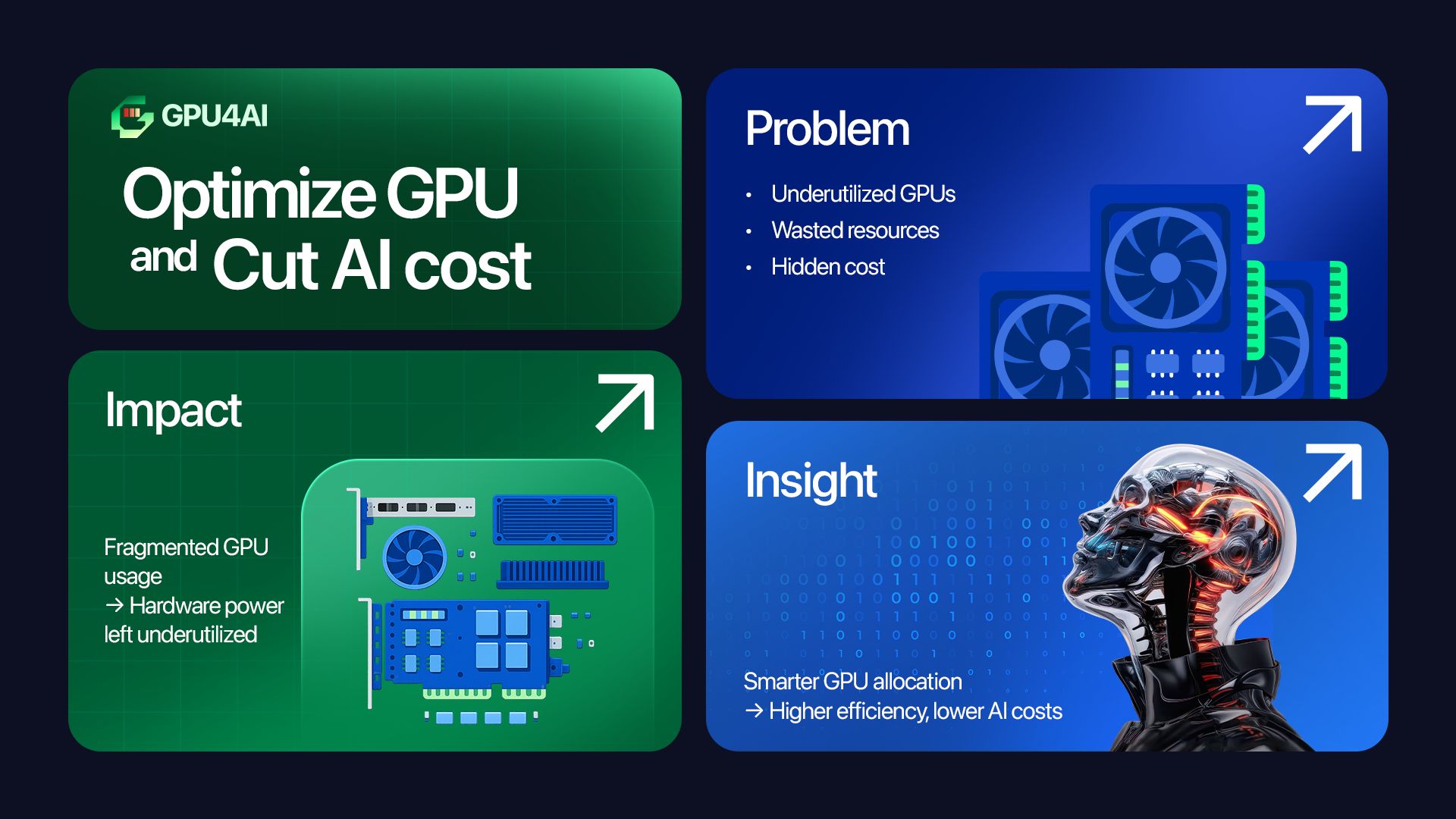

In the high-stakes world of AI development for B2B applications, where every dollar spent on compute directly impacts your bottom line, inefficiencies can silently erode your competitive edge. As builders who’ve scaled AI products from prototypes to revenue-generating systems serving enterprise clients, we’ve seen GPU fragmentation emerge as a stealthy thief of resources. It happens when your GPUs have idle capacity yet cannot be used effectively due to fragmented workloads, mismatched configurations, or suboptimal allocation. This leads to paying full price for hardware that’s only partially productive, turning what should be a growth enabler into a hidden financial drain.
The problem is not always a shortage of GPUs; it is often about failing to utilize available resources intelligently. Let’s dive into the mechanics of fragmentation, its real-world impacts on B2B AI teams, and how to mitigate it for sustainable scaling.
Understanding GPU Fragmentation: More Than Just Idle Time
At its core, GPU fragmentation occurs when workloads are divided into small, incompatible pieces that leave gaps in resource usage. Imagine a high-end GPU like an H100 with 80GB of VRAM and massive compute power, but your jobs only need 20GB bursts or light inference tasks. The GPU runs at partial load, yet you are billed for the full instance. This inefficiency compounds as teams scale, with utilization dropping below 50% while costs remain fixed.
From our experience, fragmentation stems from three common pitfalls:
Running mixed small jobs on oversized GPUs: Startups often provision powerful cards for occasional heavy training, leaving them underused for daily inference or fine-tuning. This mismatch wastes 30-60% of capacity, as smaller tasks cannot fully leverage the hardware’s parallelism.
Failing to segment workloads by requirements: Without separating high-VRAM needs (like large model training) from compute-light tasks (like edge inference), jobs compete inefficiently. Teams end up with “stranded” resources—free memory or cores that no pending job fits perfectly.
Lacking dynamic allocation mechanisms: Static scheduling leads to rigid partitioning, where one job hogs a GPU while others queue. In dynamic B2B environments, like real-time recommendation systems for e-commerce clients, this causes delays and escalates costs as you over-provision to avoid bottlenecks.
Industry data from 2025-2026 reinforces this: Reports show average GPU utilization in public clouds hovers at 40-60%, meaning enterprises waste billions annually on unused cycles. For B2B AI builders, this translates to inflated OPEX that squeezes margins, especially when inference dominates 80%+ of workloads by decade-end.
The Costly Consequences: Beyond Wasted Spend
The fallout from fragmentation is not just financial; it hampers business agility. First, GPUs stay powered on without full productivity, leading to “idle tax”—paying for electricity, cooling, and instance time on underutilized hardware. In our projects, we’ve seen this add 20-40% to monthly bills without proportional output gains.
Second, as you scale, costs balloon exponentially. What starts as minor waste in a small cluster becomes a massive overhead in production, where user growth demands more instances but utilization stays low. Enterprise clients expect 99.99% uptime and sub-500ms latency; fragmentation risks downtime or slow responses, driving churn and damaging NPS.
Third, it stifles innovation. Teams bogged down by inefficient resource management spend less time on model iteration and more on infrastructure firefighting. A counterintuitive insight: High fragmentation often masks as “GPU shortage,” prompting unnecessary purchases when better allocation could unlock 2-3x more effective capacity from existing hardware.
For regional startups serving B2B sectors like fintech or logistics, this issue is acute. Limited budgets amplify the pain, turning what could be a lean operation into one plagued by unpredictable scaling costs.
Overcoming Fragmentation: Smart Strategies for Efficient GPU Use
The good news: Fragmentation is solvable through intentional design. Shift from reactive provisioning to business-aligned orchestration. Start by auditing workloads: Categorize by VRAM, compute intensity, and duration to match jobs with appropriate GPU slices.
Implement dynamic schedulers like Kubernetes or Ray for multi-tenant sharing, allowing small jobs to fill gaps without dedicated instances. Use tools for auto-scaling and bin-packing to maximize utilization above 80%.
A key insight for B2B leaders: Invest in platforms that abstract fragmentation away. Decentralized networks aggregate idle resources globally, providing flexible, on-demand access without ownership overheads.
GPU4AI: Eliminating Fragmentation for AI Builders
GPU4AI is engineered to tackle fragmentation head-on, designed for teams building revenue-focused AI products. Our decentralized marketplace ensures high utilization by matching workloads to optimal GPUs, reducing waste and costs by up to 5x compared to traditional clouds.
We offer instant provisioning of high-end configs (H100, H200, B200), pay-per-use billing with no idle fees, and seamless scaling for mixed workloads. Whether training LLMs or running real-time inference, our system dynamically allocates resources, keeping utilization high and bills predictable.
In 2026, as AI compute demands soar, do not let fragmentation erode your margins. Turn it into an opportunity for efficiency.
Explore GPU solutions for AI teams at: https://gpu4ai.cloud/
NVIDIA-New AI Server: 10x Performance Boost Leads the Way for Future AI Infrastructure