
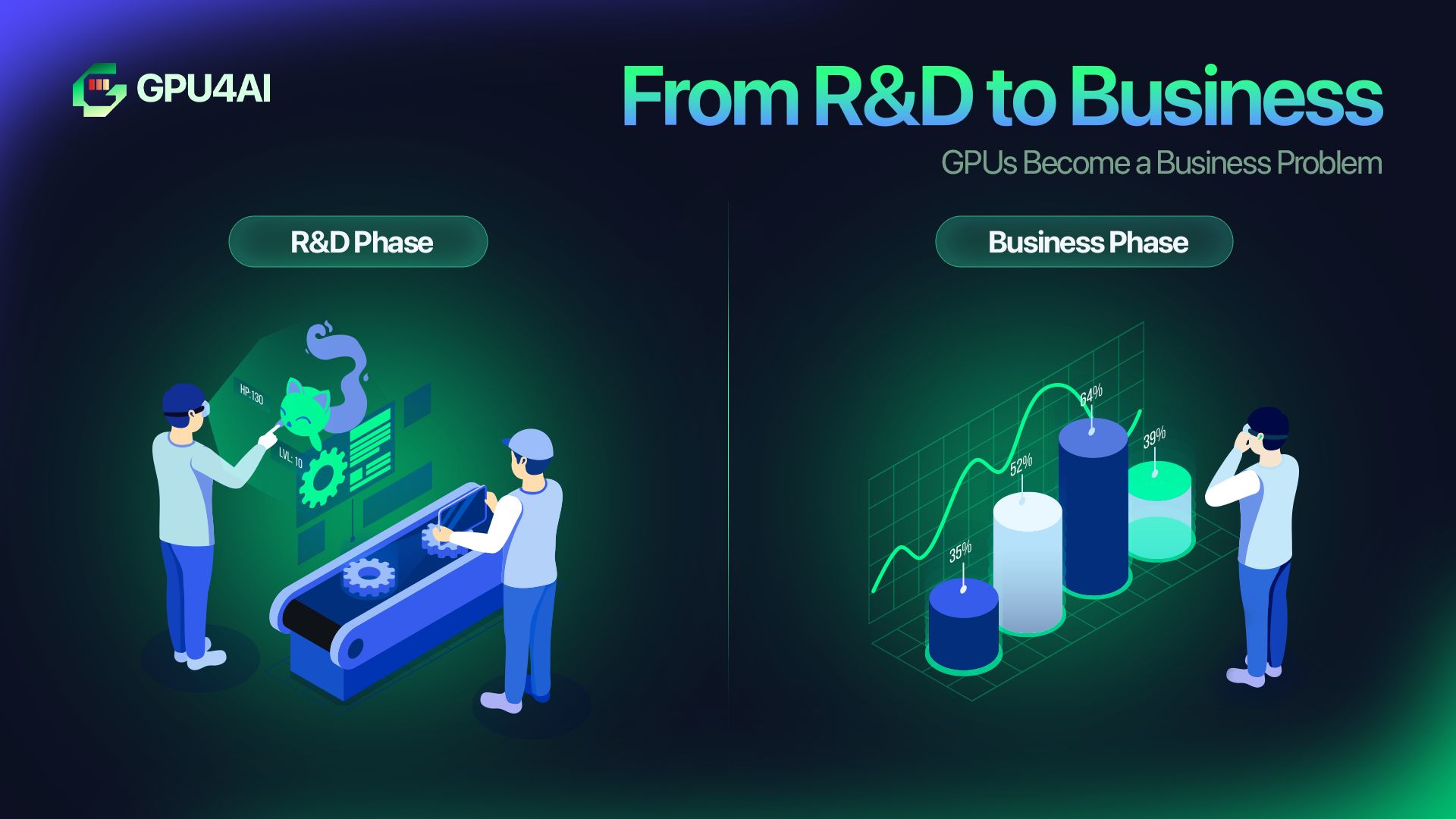

In the R&D phase, GPUs primarily serve as experimental tools: intermittent training, variable workloads, hard-to-measure costs that remain acceptable because the goal is exploration and idea validation. Many founders tolerate high burn rates in exchange for faster iteration cycles, since revenue is not yet tied to the model.
But when the AI product starts generating real revenue through SaaS platforms, enterprise AI assistants, or recommendation systems serving paying customers, GPUs cease to be mere technical hardware. They become a core component of unit economics and the overall business model. The problem shifts completely. It is no longer about running the model successfully; it is about stable operations, meeting service level agreements, low response latency, and predictable, controllable costs. Every downtime incident, slow response, or sudden bill spike directly impacts customer churn, satisfaction, referral willingness, gross margins, and revenue scalability.
This transition phase is where many AI startups in Vietnam and the region experience a severe infrastructure shock. They continue running production with an R&D mindset: prioritizing cheap spot instances, accepting queues for resources, and over-optimizing models solely to save compute.
That mindset works during experimentation. Once serving paying customers, especially enterprise clients, the consequences become evident:
- Unstable user experience
- Enterprise customers demand 99.9%+ uptime SLAs
- Inference costs consume 60-80% of total operating expenses
- Growth velocity is throttled by infrastructure that should be an enabler
The Shift from R&D to Business Reality
During R&D, the top priority is experimentation speed and minimal cost. Teams accept low GPU utilization (typically 30-50%), tolerate interrupted training jobs, and treat inference latency as secondary since users are mostly internal testers. GPU costs may account for 70-80% of monthly burn, yet founders accept it because the objective is building proofs-of-concept and validating ideas.
In the business-driven phase:
- Inference dominates: Industry reports for 2025-2026 project inference workloads will exceed 80% of total AI compute demand by decade-end. Training occurs periodically, but inference runs 24/7 with user volume scaling alongside revenue.
- SLAs and reliability become non-negotiable: Enterprise clients (fintech, healthcare, logistics) require sub-500ms latency, 99.99% uptime, and zero-downtime scaling. A single hour of outage can lose thousands of users or breach contracts.
- Cost predictability determines profitability: Bill shocks from preempted instances or demand surges can turn gross margins negative. Teams often cut features or cap user growth because per-inference costs become unpredictable.
- High utilization is essential: 50% idle GPUs equal 50% wasted spend. Production workloads are bursty with peak-hour surges, demanding flexible auto-scaling without over-provisioning.
- A counterintuitive truth: Buying stronger GPUs does not automatically solve the issue. Even H100 or B200 cards speed up training and inference, but without proper orchestration, smooth data pipelines, and aligned cost models, old bottlenecks persist at larger, more expensive scale. Many startups upgrade hardware yet remain slow due to lack of separation between R&D clusters (low-priority experimentation) and production clusters (high-availability, auto-scaling).
GPU Solution: Planning According to Business Logic, Not Just Technical Specs
To transition smoothly from R&D to production, teams must divide infrastructure into two distinct layers, each optimized for different objectives.
1/ R&D Layer:
Retain cost-saving mindset. Use spot or secondary resources, accept queues, prioritize cost-per-experiment. No need for high SLAs. Goal is fast learning at low cost.
2/ Production Layer:
Prioritize predictability, scalability, and reliability. Requirements include:
- Instant provisioning without multi-hour or multi-day waits
- Auto-scaling based on real demand, handling bursts without bill shocks
- High utilization through multi-tenancy or efficient orchestration
- Transparent cost tracking (per-token, per-user) aligned with revenue
- Enterprise-grade reliability (99.99% uptime, SOC 2 compliance, contractual SLAs)
This is not about stronger GPUs; it is about infrastructure aligned with business model: true pay-as-you-go, scaling with revenue growth, and low marginal costs as user volume increases.
GPU4AI: Infrastructure Enabling Smooth Transition for Vietnamese AI Teams / R&D to Business
GPU4AI is built specifically for teams at this critical inflection point: moving from impressive tech to sustainable revenue-generating businesses.
We provide:
- Instant access to high-end GPUs (H100 SXM from $3.29/hour, H200, B200), deployable in 60 seconds, no queues.
- True pay-as-you-go billing, no long-term commitments, 61-78% cheaper than AWS, Azure, GCP for equivalent configurations.
- Auto-scaling (Terraform, Kubernetes) from 1x to 8x+ GPUs, RDMA networking for low-latency multi-GPU training and inference.
- 99.99% uptime, SOC 2 Type II compliance, enterprise SLAs suitable for B2B clients demanding reliability.
- Full framework support (PyTorch, vLLM, Triton, Ray) across R&D and production environments.
- $100 free credits to test production workloads risk-free.
The result: Teams keep R&D flexible and cost-efficient while production scales smoothly with revenue, controls per-inference costs, and avoids infrastructure shocks during rapid user growth.
In 2026, when inference costs determine survival, GPUs should not be barriers; they must become business levers that enable revenue growth without breaking cost structures.
Explore GPU solutions for AI teams at: https://gpu4ai.cloud/
Is GPU Access Widening the Gap Between AI Big Tech and Startups?